Axum
Axum
Capital of a thousand-year empire and legendary guardian of the Ark of the Covenant, Axum reveals its giant obelisks and royal tombs deep in the heart of Tigray.
Nestled in the north of the country, Axum is the birthplace of Éthiopie's most significant civilization and Orthodox Christianity. With its towering carved obelisks and sacred relics, this city has been designated a UNESCO World Heritage site, immersing you in a world apart—a journey back to the days of the Aksumite Empire.
The History of Aksumite Civilization
The Aksumite kingdom was among Africa's greatest commercial empires, experiencing a period of particular prosperity around the 4th century BCE.
Mystery still surrounds the origins of Aksumite civilization. According to some accounts, the Sabaeans founded the city, having crossed the Red Sea from South Arabia (Yemen) to settle in the region. Other narratives speak of an earlier kingdom called "D'mt" or "Da'amot," established well before the Sabaeans arrived in the 4th and 5th centuries BCE.
Axum benefited from a strategic location that favored exchanges between the Mediterranean and India. Maritime commerce became the engine of its development.
Around 100 BCE, a trade route linking Egypt and India was established, passing through the Red Sea. Navigators exploited monsoon winds to reach India via the Oman Sea. Maritime and commercial traffic surged, particularly because Romans and others valued the goods of the Subcontinent. This enabled Adulis to become the principal export port for merchandise—incense, ivory, exotic animals, gold, and more—flowing between Africa and India.
Axumite rulers developed sophisticated strategies to meet Roman demand and compete with Indian rivals. They became the primary suppliers of ivory to Egypt and major African powers, and succeeded in conquering Kushite territories around the 1st century CE.
When the Persian Empire invaded, Axum aligned with the Byzantine Empire. The city experienced its golden age in the early 6th century, though this prosperity proved short-lived. Its decline began in the 7th century, when production of Aksumite coins diminished. By the 8th or 9th century, an assault led by the pagan queen Yodit hastened its collapse. To mark her victory, she burned churches and destroyed all existing forms of literature in Axum.
Other accounts attribute the kingdom's loss of prominence to competition from Arab traders, who also exploited maritime routes to India to supply East Africa with ivory and gold. Axum's commercial situation worsened with the drying of the Nile's floods. Families sought refuge in the highlands, triggering overpopulation and diminishing supply yields.
The decline of the Aksumite Empire marked a dark period in Éthiopie's history, lasting until the rise of the Zagwe dynasty in the 11th century.
Axum Today
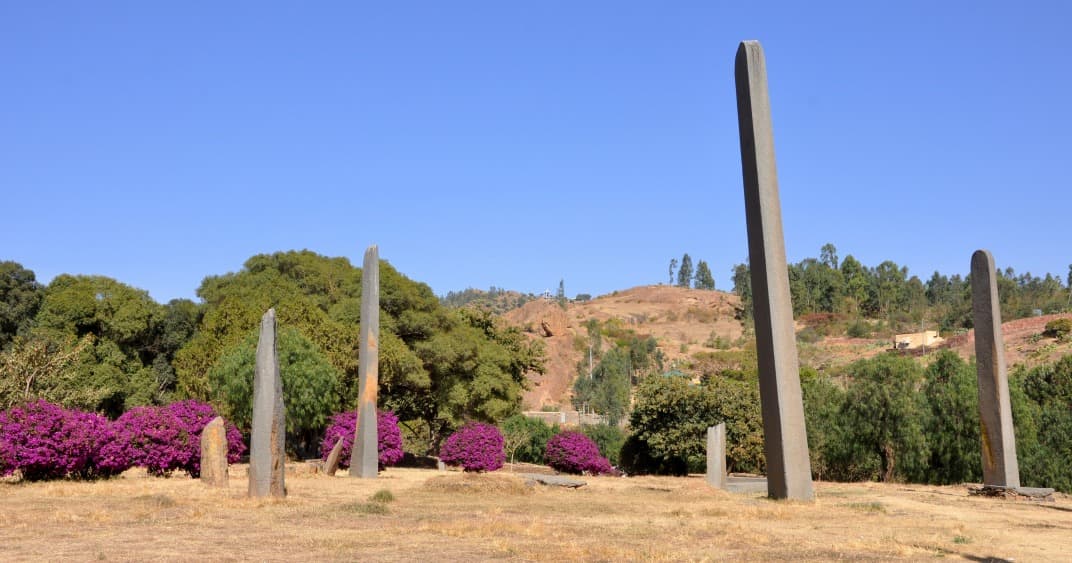
From its rich past, the city has preserved vestiges of Aksumite civilization. Stelae, royal tombs, obelisks, and other ancient monuments testify to its former glory. Today, Axum has become a significant archaeological site. Your stay in this city will be a journey into the heart of one of Éthiopie's—indeed Africa's—greatest kingdoms. If you possess a curious spirit, Axum, despite its political decline around the 10th century, will not lack appeal to captivate you.
Stelae form the symbol of Axum. The city contains nearly 300 of them. Composed of multiple tiers with windows and lockable doors, they are adorned with decoration typical of the Aksumite kingdom. One reached a height of 33 meters but collapsed over time, its base unable to support its 400-kilogram weight. Nevertheless, ruins remain visible in the stelae field.
Nicknamed the "false door tomb" by geologists, Remhai's Tomb is a must-see attraction in Axum. It houses a sarcophagus whose occupant remains unknown. Some say it may be hollow.
Do not miss the Church of Saint Mary of Zion complex, which also holds an important place in Axum's history. Women are not permitted to cross the threshold of the ancient church. A small chapel nestles between the two structures. According to local tradition, the Ark of the Covenant is said to be preserved here, guarded by a man condemned to live within the building. It is impossible to verify these claims, as this section is off-limits to visitors.
Also visit the tombs of Kings Gabra Masqal and Kaleb, which contain three sarcophagi. Along the way, note the stone carved in three languages, standing 2.5 meters high. This structure commemorates battles fought by Aksumite kings against their enemies. Complete your circuit with the ruins of Dungur Palace, the residence of the Queen of Sheba, discovered in 1996 during a French archaeological mission. Adopting an irregular quadrilateral form, the site spans 3,000 square meters. Explore here a large stelae field, including that of the mother of Menelik, founder of Addis Ababa.
Climate in Axum
Temperatures in the city range between 13 to 18°C. The best months to visit Axum are January, February, March, October, November, and December.
Ethiopian Airlines offers regular flights to Axum departing from Addis Ababa.
By road, shuttles depart regularly for Axum from Gondar, Adwa, or Mekelle.
The best way to discover Axum is on foot. However, you can also opt for a taxi. If you plan to explore the surrounding areas, rent a 4x4.
What to Do and See?
- Visit the archaeological museum: By starting your tour at the museum, you gain access to all the city's historical vestiges with a single ticket costing approximately 60 birr.
- Discover the stelae field and King Remhai's tomb
- Explore the Church of Saint Mary of Zion complex and the monument of the three locations
- Visit the May Shum Reservoir, also known as the "Queen of Sheba's Pool," and more.
Want to discover this destination?
Our local advisors design your tailor-made trip.