Ura Kidane Mehret Church
Ura Kidane Mehret Church
On the Zege peninsula, accessible by boat from Bahir Dar, Ura Kidane Mehret church houses some of Éthiopie's best-preserved Ethiopian Orthodox frescoes, nestled in tropical forest on the shores of Lake Tana.
On the Zege peninsula, overlooking Lake Tana, Ura Kidane Mehret church stands as one of Éthiopie's most remarkable Orthodox sanctuaries. Tucked within dense forest, it distinguishes itself through interior murals that blanket the entire walls of the rotunda. Lake Tana, source of the Blue Nile, encircles the peninsula on three sides, making boat access the only way in. This isolated setting has sheltered the site for centuries.
Quick Practical Guide
- Access: boat from Bahir Dar (approximately 1 hour 30 minutes depending on vessel type); walking through forest from Zege landing
- Entry: paid (site entrance fee + photography fee charged separately)
- Dress code: shoulders and knees must be covered; shoes removed before entering the rotunda
- Recommended duration: 1 hour 30 minutes to 2 hours on site, including forest walk
- Accessibility for mobility: challenging — unimproved forest path, boat access required
What to See
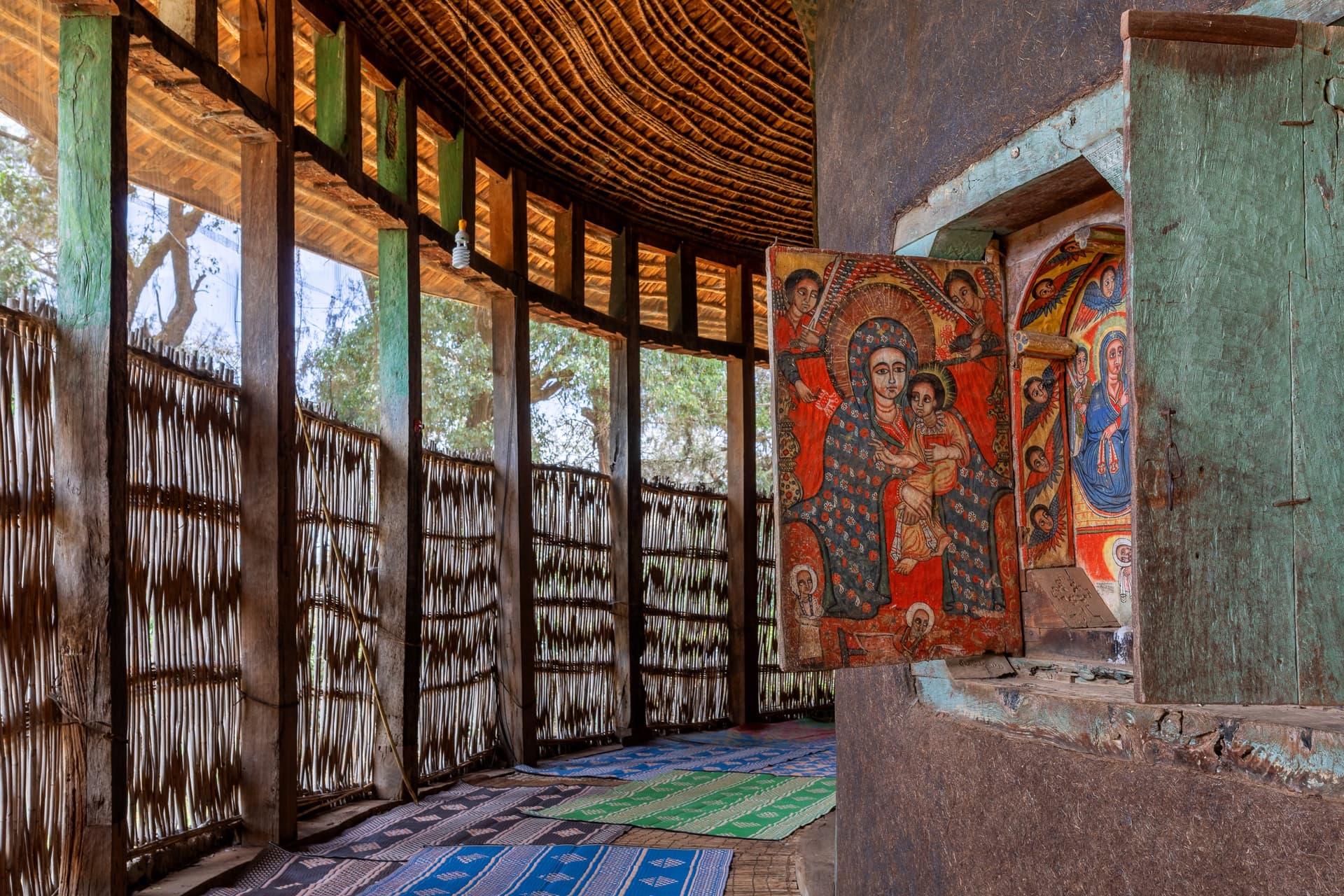
The church follows the traditional Ethiopian circular plan with three concentric levels: the qené mahlet (outer nave), the qeddest (communion hall) and the meqdas (holy of holies, restricted to priests). Frescoes in the qeddest depict biblical scenes, saints and angels on ochre and brick-red backgrounds. The attached museum houses processional crosses, illuminated manuscripts and ancient liturgical vestments.
History and Context
According to tradition, the monastery's foundation dates to the fourteenth century. The Zege peninsula long served as refuge for Christian communities during invasions. The current church structure likely dates from the seventeenth or eighteenth century, though the site has been venerated far longer. The name Kidane Mehret means "Covenant of Mercy" and refers to the Virgin Mary, to whom the church is dedicated.
Highlights of Your Visit
Interior Frescoes
The murals impress through their preservation and narrative density. Each register tells an episode: Annunciation, Crucifixion, lives of Ethiopian saints. Faces with their distinctive large expressive eyes exemplify classical Ethiopian pictorial style.
The Monastery Museum
The treasury room displays liturgical objects spanning centuries: worked metal crosses, embroidered ceremonial robes, wooden icons and illuminated parchments in Ge'ez. A guardian priest typically comments on major pieces.
The Zege Forest
The path from the landing crosses dense tropical forest where wild coffee plants grow, alongside incense trees and giant figs. The peninsula remains one of the few places where Arabica coffee still grows in semi-wild state.
Etiquette and Visit Rules
- Remove shoes before entering the main rotunda.
- Shoulders and knees covered for all visitors.
- Women during menstruation are traditionally requested not to enter the qeddest.
- The meqdas (inner sanctuary) is reserved for Orthodox priests.
- Speak quietly; the church is an active place of worship.
- Photography inside requires an additional fee paid at entrance.
Photography Tips
Natural light barely penetrates the rotunda: bring a camera capable in low light or a lightweight tripod. Frescoes render best without flash, which is often prohibited. Outside, morning light (before 10 a.m.) illuminates the painted entrance façade without backlighting. The forest path offers striking perspectives of coffee plants shot upward.
Location and Access
Ura Kidane Mehret sits on the Zege peninsula, reachable only by boat from Bahir Dar, the regional capital of Amhara. Motor boats depart from Bahir Dar port; duration varies by vessel. From Zege landing, a forest trail of roughly twenty minutes leads to the church. No vehicles operate on the peninsula. Mobility access is very difficult due to boat travel and unimproved paths. Local guides offer their services at the landing.
In the Surroundings
- Kebran Gabriel Monastery — another island monastery on Lake Tana, reserved for men, renowned for its manuscript treasury.
- Debre Maryam Monastery — on a lake island, boat access, more remote atmosphere.
- Blue Nile Falls (Tis Abay) — about an hour's drive from Bahir Dar; falls can be combined with lake visits in a day.
- Bahir Dar — essential departure point, featuring market, lakeside restaurants and boat agencies.
Frequently asked questions
Dry season (October to May) is ideal: the lake remains safely navigable and forest paths stay dry. Avoid rainy season (June-September) when boat crossings may be disrupted.
Technically yes, but a local guide greatly enriches the experience: they interpret frescoes, explain Ethiopian Orthodox liturgy and facilitate museum access. Guides offer services at Zege landing.
Yes, women are welcome. Only the meqdas (inner sanctuary) is reserved for priests. Attire covering shoulders and knees is mandatory for all visitors.
Yes. Bahir Dar agencies offer full-day boat circuits combining Ura Kidane Mehret with other island monasteries. This is the most efficient way to explore the lake.
It is allowed for an additional fee paid at entrance. Flash is generally discouraged or forbidden to preserve frescoes. Verify current rules upon arrival with the guardian.
Allow a full day: round-trip boat crossing, peninsula walk, church and museum visit. Depart early to maximize light and avoid afternoon heat on the lake.
Interested in this visit?
We can include it in your personalised itinerary.