Lake Assal (Lac Assale)
Lake Assal (Lac Assale)
In the Danakil Depression, 120 meters below sea level, Lake Assal spreads its white salt crusts between volcanoes and desert. Afar caravans still carve salt blocks by hand here, as they have for centuries.
Lake Assal, also spelled Assalé, lies within the Danakil Depression in northeast Éthiopie. At approximately 120 meters below sea level, it ranks among Africa's lowest points. Its hypersaline waters—among the most concentrated on Earth—deposit thick white salt crusts that the Afar people have exploited for centuries. The landscape, mineral and almost lunar in character, contrasts sharply with neighboring volcanoes and hydrothermal springs.
Quick practical information
- Access: 4×4 only, from Mekele (the usual starting point for Danakil circuits) or from Semera/Logia.
- Recommended duration: 1 to 2 hours on-site, generally included as part of a multi-day Danakil circuit.
- What to wear: Closed-toe shoes essential—salt crystals are sharp; long, lightweight clothing protects against sun and extreme heat.
- Heat: Temperatures among the highest on the planet; avoid midday hours (10 a.m.–3 p.m.).
- Safety: The Afar region carries travel advisories; a local guide and armed escort are mandatory for all organized tours.
- Accessibility for visitors with reduced mobility: Very rough terrain, not suitable.
What you'll see
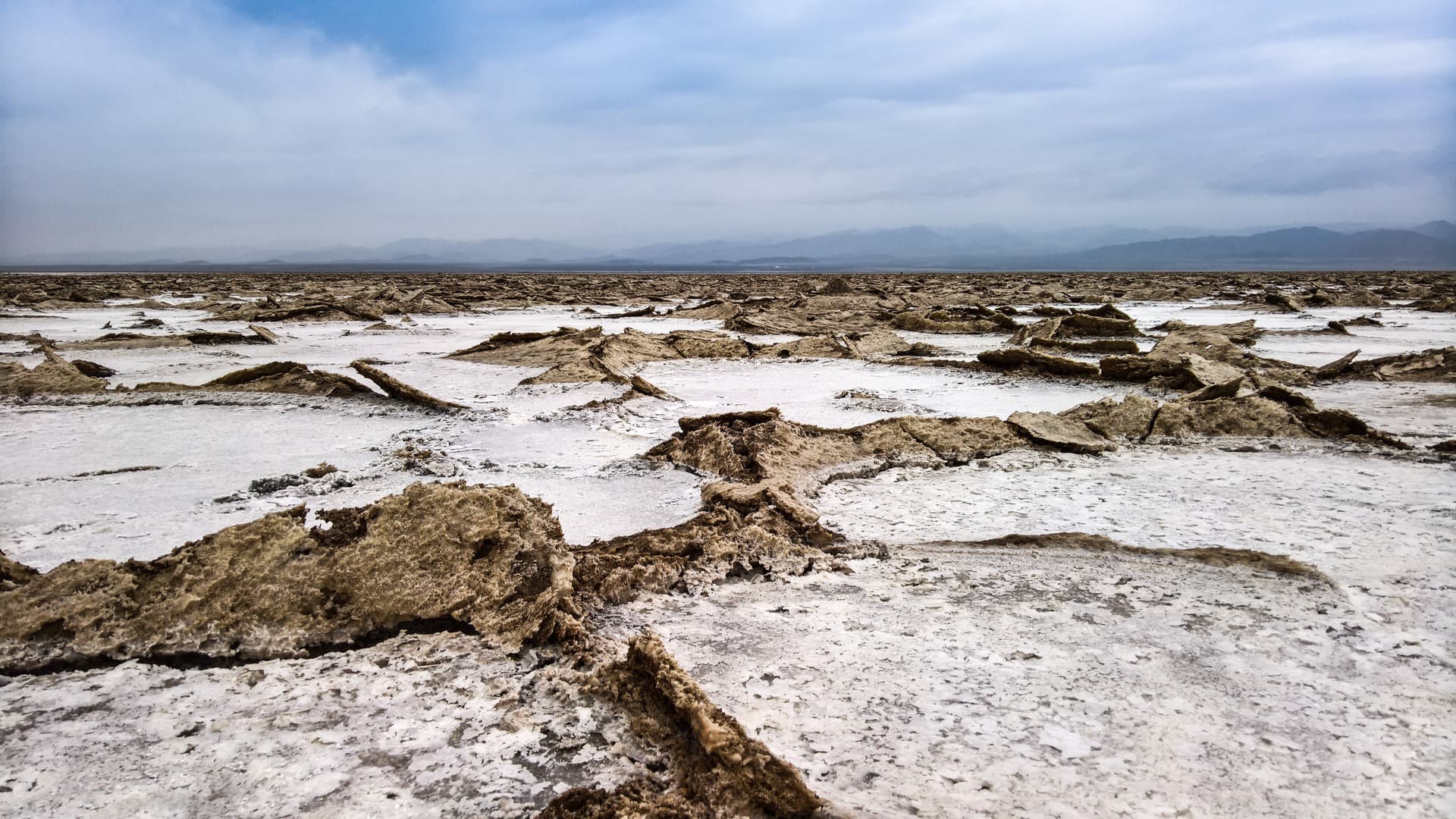
The lake's surface appears as a white mirror streaked with pink and blue reflections depending on the light. Blocks and plates of crystallized salt form natural geometric reliefs. On the shores, caravans of camels laden with salt slabs still depart toward interior markets—a commercial scene inherited from antiquity. In the background, volcanoes of the Danakil Depression line the horizon.
History and context
Danakil salt long served as a medium of exchange in Éthiopie: carved blocks, called amolé, circulated as far as the highlands. The Afar people traditionally control the extraction and trade of this salt. The Danakil Depression is geologically active: it sits at the triple point where the African, Arabian, and Somali rifts converge, explaining the presence of volcanoes, acidic springs, and salt lakes like Assal.
Highlights of your visit
Salt crystals
Walking carefully across the crust, you'll observe crystalline formations in rosette and prismatic patterns. The salt concentration far exceeds that of the Dead Sea, making virtually all aquatic life impossible.
Afar caravans
Early in the morning, groups of Afar men carve rectangular slabs with pickaxes and load them onto camels. Witnessing this labor—unchanged for centuries—ranks among the most memorable experiences on the Danakil circuit.
Reflections and colors
Depending on the hour and season, the surface shifts from pure white to pale pink to silvery gray. At dawn, before heat creates mirages, colors are sharpest and most photogenic.
Photography tips
Dawn is your best moment: low-angle light, no mirages, active caravans. Shield your camera from salt dust and heat. A polarizing filter reduces glare from the white crust. Frame caravans against the lake to convey the immensity of the site.
Location and access
Lake Assal lies within the Danakil Depression, Afar Region, in northeast Éthiopie. The city of Mekele (Tigray) is the most common starting point for organized 3- to 4-day circuits covering Lake Assal, Erta Ale volcano, and Dallol's hydrothermal springs. The 4×4 track from Mekele crosses desert landscapes and Afar villages. No public transport reaches the site.
Nearby attractions
- Dallol — acidic springs in yellow and sulfur-green hues, among Earth's most otherworldly landscapes.
- Erta Ale — shield volcano with a continuously active lava lake, accessible at night from a base camp.
- Ahmed Ela — Afar village and water resupply point for Danakil circuits.
Frequently asked questions
The dry season, November to February, offers slightly less extreme temperatures and more passable tracks. Avoid the rainy season (July–August) when some routes become impassable.
Technically possible—the salt concentration makes you float—but extreme salinity irritates eyes and wounds. The heat and distance from medical care demand caution.
Yes. Éthiopie's authorities require an approved guide and armed escort for all visits to the Afar region. No independent travel is permitted.
Most organized circuits last 3 to 4 days from Mekele, combining Lake Assal, Dallol, and Erta Ale. It's difficult to visit the lake alone outside this complete circuit.
Intensive hydration (several liters of water daily), maximum sun protection, sturdy closed-toe shoes. Heat can exceed 113°F (45°C); fragile individuals should consult a doctor before departure.
Always ask permission before photographing people. Your English-speaking local guide will facilitate contact and explain customs. A direct financial contribution is often appreciated.
Photos
Interested in this visit?
We can include it in your personalised itinerary.