Harar and the East
Sixteenth-century fortified city, 80 mosques, Harerghe arabica coffee and hand-fed hyenas: eastern Éthiopie turned toward the Horn of Africa.
Harar and its hinterland occupy the eastern edge of the Éthiopian plateau, between 1,600 and 2,000 metres in altitude, before the land slopes down towards the Somali lowlands and the Djibouti border. From our office in Addis Ababa, we arrange access to this region either by a 1-hour flight to Dire Dawa, or overland in two days, with a stop at Awash National Park, crossed by the river of the same name and home to beisa oryx, Soemmerring's gazelles and Somali ostriches. The Awash Falls, where the river plunges into a basalt canyon, mark entry into another world—more arid, hotter, and oriented more towards the Horn of Africa than towards the Christian highlands of the North.
Harar Jugol, the old fortified city, has been a UNESCO World Heritage site since 2006. Within its sixteenth-century stone walls, 3.5 km long and pierced by five gates, wind 368 alleyways, more than 80 mosques and a hundred shrines. According to local tradition, it is the fourth holiest city in Islam after Mecca, Medina and Jerusalem. The Adaré people, sedentary and urban, have lived here for nearly a millennium, speaking their own Semitic language, Harari, and inhabiting houses with walls painted red, green and blue, whose reception rooms, the gar, display on wall shelves porcelain tableware and woven baskets offered as dowries.
The region is traversed by a singular agricultural economy: qat, a shrub whose leaves are chewed for their stimulating effect, structures daily life in Aweday, a large market 15 km from Harar, where each morning producers from the surrounding hills converge with buyers from Djibouti and Somalia. Arabica coffee, of which the Harerghe region is one of the historical heartlands, is cultivated between 1,500 and 2,100 metres; the Harar longberry variety, naturally dried, retains notes of blackberry and wine. We gladly take our travellers to an Adaré house for a coffee ceremony lasting a good hour, with roasting of green beans in a pan and three successive services, the abol, the tona and the baraka.
Beyond Harar, eastern Éthiopie remains little visited. Dire Dawa, the country's second city, founded in 1902 along the Franco-Éthiopian railway line linking Djibouti to Addis Ababa, retains Italian and French colonial architecture in its Kezira district, and a large covered market, the Kafira, where Oromo, Somali, Harari and Afar traders cross paths. An hour north of Dire Dawa, the rock paintings of Laga Oda and Porcupine, dated between 5,000 and 3,000 years ago, depict cattle herds and hunting scenes, testimony to a time when the region was more humid.
In the evening, at nightfall, two men, one at the Erer Gate, the other near the shrine of Aw Ansar, feed spotted hyenas that emerge from the bush by hand and mouth. The practice dates back at least to the nineteenth century and once served as a pact between the city and the scavengers. It is not a spectacle staged for visitors; it is a routine that continues whether or not there is an audience. We take you there without theatrical staging, explaining the ritual and social context that accounts for why Hararis tolerate, and sometimes maintain, the nocturnal presence of hyenas in their alleyways.
This region thus stands out distinctly from the rest of Éthiopie: Islam rather than Orthodox Christianity, Cushitic and Eastern Semitic languages rather than Amharic, an economy oriented towards the Red Sea and the Indian Ocean rather than towards the highlands. It is this contrast, more than the list of sites, that justifies the detour.
To discover
The alleyways of Harar Jugol. Slow walk through the fortified city, among the ochre-walled Adaré houses and small neighbourhood mosques, entering by the Shewa Gate and passing through the Gidir Megala market.
Coffee ceremony in an Adaré house. An hour seated on the cushions of the gar, following the roasting of green beans, frankincense and the three services, in the company of a Harari family.
The hyena man at the Erer Gate. As night falls, close-range observation of the feeding of wild spotted hyenas, a practice attested since the nineteenth century.
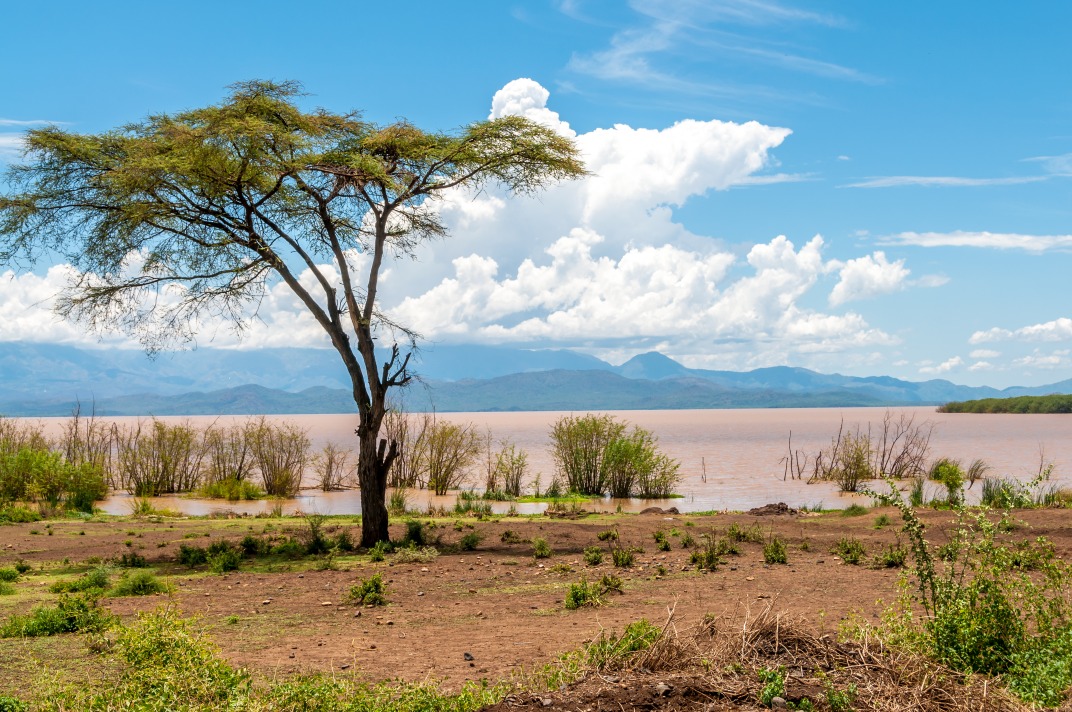
Awash National Park. A stop on the route from Addis: acacia savanna, beisa oryx, Soemmerring's gazelles and basalt falls of the Awash River, 225 km from the capital.
Aweday qat market. Early morning, ballet of bundles of fresh leaves wrapped in banana leaves, negotiated in Oromo between hill producers and wholesalers bound for Djibouti.
When to go
The best time for Harar and the East spans October to March, with daytime temperatures around 22 to 25°C in Harar (1,885 m altitude) and cool nights dipping to 12-14°C in December and January. Dire Dawa, at 1,200 m, is noticeably warmer, often 28 to 32°C during the day over the same period. Rainfall concentrates in two seasons: the small rains, or belg, in March-April, and the heavy rains in July-August, with moderate totals compared to the rest of Éthiopie, around 700 mm annually in Harar. Awash Park, by contrast, can exceed 35°C in April-May and becomes pleasant again from October onwards.
The month of Ramadan substantially alters the rhythm of the old city: shops closed during the day, lively streets after the breaking of the fast. If you want to see Harar in its normal functioning, it is better to avoid this period, whose dates advance each year by about eleven days. The Shuwalid festival, seven days after Eid al-Fitr, marks in contrast a high point, with processions, singing and visits to shrines.
Practical advice
We recommend three full days on site to grasp Harar well: one day for Jugol and its alleyways on foot, one day for peripheral markets (Aweday, Babile, Thursday camel market) and rock paintings around Dire Dawa, one day at a slower pace for the coffee ceremony and the hyena episode in the evening. The simplest entry point remains Dire Dawa airport, served by Ethiopian Airlines in 1 hour from Addis, followed by a 55 km road, or 1.5 hours, to Harar. The road variant departing Addis requires two days with a night at Awash, and has the advantage of linking on to the national park.
Harar and the East combine naturally with a stay in the historic North (Lalibela, Gondar, Axum) for those wanting to compare the two religious poles of Éthiopie, Orthodox Christian and Sufi Islam. Combination with the Danakil is logistically possible but requires returning via Addis or Mekele. Hotel comfort in Harar is adequate if unremarkable, with two or three reliable addresses within Jugol and nearby; travellers seeking high-end beach comfort will not find what they seek. This region is best suited to travellers curious about Muslim urban cultures, coffee and craft enthusiasts, and those who accept a slow pace, made of long conversations and observation.