Simien Massif
Basalt plateau carved by 1,500-meter cliffs north of Gondar, sanctuary of geladas and walia ibex, explored on treks lasting three to ten days to Ras Dashen.
The Simien Massif occupies a vast basalt plateau in northwest Éthiopie, shaped by volcanic eruptions forty million years ago. Erosion has carved this foundation into vertical cliffs of 1,000 to 1,500 meters, isolated pinnacles, and rocky amphitheaters opening toward the lowlands of Tigré. The national park, established in 1969 and UNESCO-listed, covers 412 km² and peaks at Ras Dashen at 4,533 meters, Africa's fourth-highest summit. Our team organizes departures from Debark, a market town at 3,100 meters and the park's administrative gateway, three hours by road from Gondar along a recently resurfaced asphalt track.
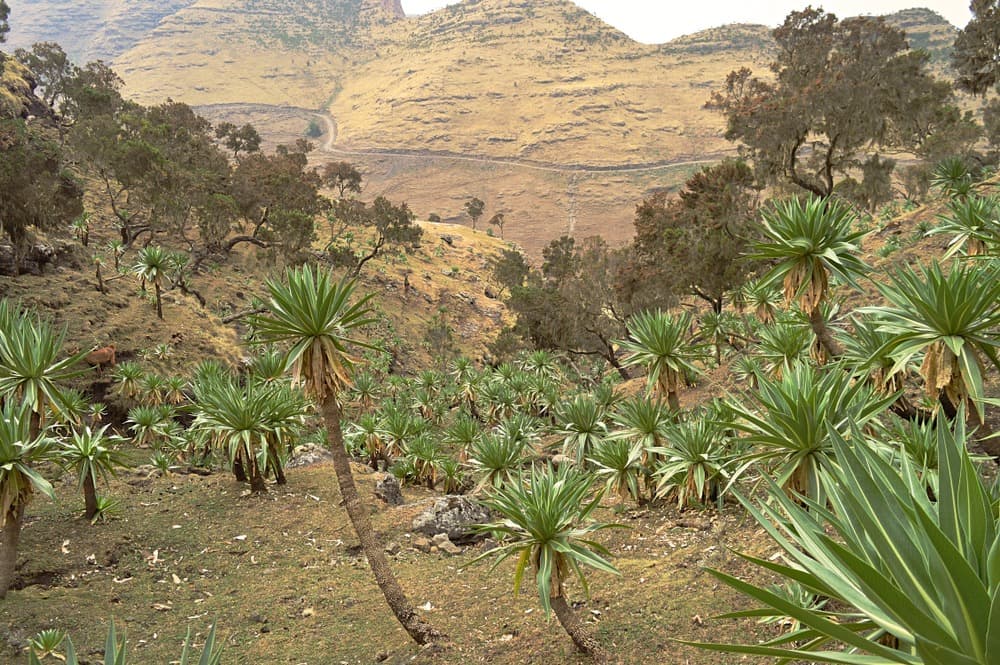
Three vegetation zones succeed one another by altitude. Between 2,000 and 2,700 meters, fields of teff and barley cultivated by Amhara farmers alternate with hamlets of dry-stone tukuls. From 2,700 to 3,700 meters, Afromontane forest blends junipers, hagenias, and wild olives. Higher still, the Afroalpine zone displays five-meter-tall giant lobelias, tree groundsels, and helichrysum meadows—a landscape found only on a handful of East African highlands.
The wildlife alone justifies the journey. Geladas, primates endemic to Ethiopian highlands, live in troops of 200 to 800 individuals approachable within meters near Sankaber and Chennek. They graze in file, the only primates on Earth for whom grass is the primary diet. The walia ibex, an endemic species reduced to roughly 1,000 individuals, can be observed on the cornices of Imet Gogo and Bwahit. The Abyssinian wolf, more elusive, frequents high-altitude plateaus above 3,700 meters, hunting mole rats. The bearded vulture and white-necked raven complete the cliff-dwelling birdlife.
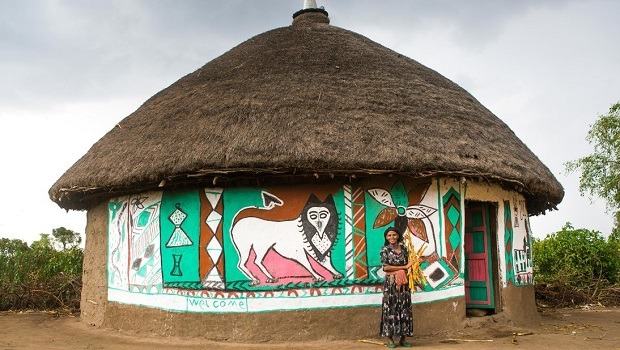
On the human side, the massif is inhabited by Orthodox Amhara farmers practicing cereal agriculture and transhumant herding of sheep, goats, and cattle. The villages of Gich, Ambaras, and Mekarebya, situated on the park's edge, still live largely in self-sufficiency. Some residents were relocated to the plains as part of the park's management plan—a locally sensitive issue. Orthodox festivals punctuate the year: Genna in January, Timkat in late January, Meskel in late September, and weekly markets in Debark and Mekane Berhan draw producers from surrounding hamlets.
Trekking is the natural way to explore Simien. Standard routes link camps at Sankaber (3,250 m), Geech (3,600 m), Chennek (3,620 m), and Ambiko (3,200 m), strung along the plateau's northern rim. Three days suffice to reach Imet Gogo and its 360-degree panorama. Five days allow you to include the Bwahit viewpoint at 4,430 meters. Eight to ten days are needed to reach Ras Dashen from the village of Ambiko, with an extra night in Mekarebya. The park requires an armed scout, an accredited local guide, and muleteers, whom we coordinate from Debark.
Must-see highlights
Imet Gogo viewpoint at 3,926 m. Rocky promontory accessible in a day from Geech, open on three sides above the cliffs. The most comprehensive vantage point over the plateau's northern edge and sculpted pinnacles.
Gelada troops at Sankaber. On-foot approach to family groups grazing without alarm, late afternoon when they descend from cliff-top roosts.
Ras Dashen ascent. Eight to ten-day trek from Debark via the Bwahit pass at 4,430 m and the village of Ambiko. Summit at 4,533 m reached in one long climbing day, positive elevation gain of 1,400 m.
Jinbar waterfalls. A 500-meter cascade plunging into Geech canyon during the rainy season and into October, visible from the plateau rim two hours' walk from Geech camp.
Saturday market in Debark. Exchange between farmers from highland hamlets and merchants from Gondar: teff grains, woven baskets, sheep, berbéré spices. An excellent introduction before ascending to the plateau.
Best time to visit
The ideal period runs October through March. The kremt rains, intense from late June through mid-September, render trails muddy and regularly fog-soak camps. In October and November, meadows remain green and Jinbar waterfalls flow at full force. December through February see clear daytime skies with temperatures of 12 to 18 °C, but nights drop to -2 °C at Chennek and to -7 °C at Ambiko camp before Ras Dashen's ascent. Frost is frequent and rime coats tents at dawn.
March through May, the belg season, bring afternoon thundershowers, still manageable for short treks. We advise against July and August, when rainfall exceeds 300 mm monthly and views are routinely obscured. Essential gear: sleeping bag rated -5 °C minimum, down jacket, and windbreaker even in dry season.
Practical advice
Allow four to six days on-site for genuine discovery: one day driving Gondar to Debark, three to four trekking days including Sankaber, Geech, and Chennek, then return. For Ras Dashen, plan ten to eleven days total. Access is by road from Gondar, whose airport has daily flights from Addis Ababa in one hour. Simien pairs logically with the historic North (Gondar, Lalibela, Aksum) over a fifteen to twenty-day circuit and can combine with the Danakil Depression for travelers wanting to contrast high plateaus with salt desert.
Comfort is basic but adequate: bivouacs in official camps, basic sanitation, meals prepared by our cook. Two lodges—Simien Lodge at Buyit Ras (3,260 m, Africa's highest) and Limalimo Lodge near Limalimo—allow a less strenuous approach with day hikes. The region suits hikers accustomed to altitude and self-sufficient walking five to six hours daily. Families with children from age 12 can consider a short format from Limalimo Lodge. Contemplatives will find their satisfaction on viewpoints accessible by vehicle up to Chennek.