Aksum Stelae
Aksum Stelae
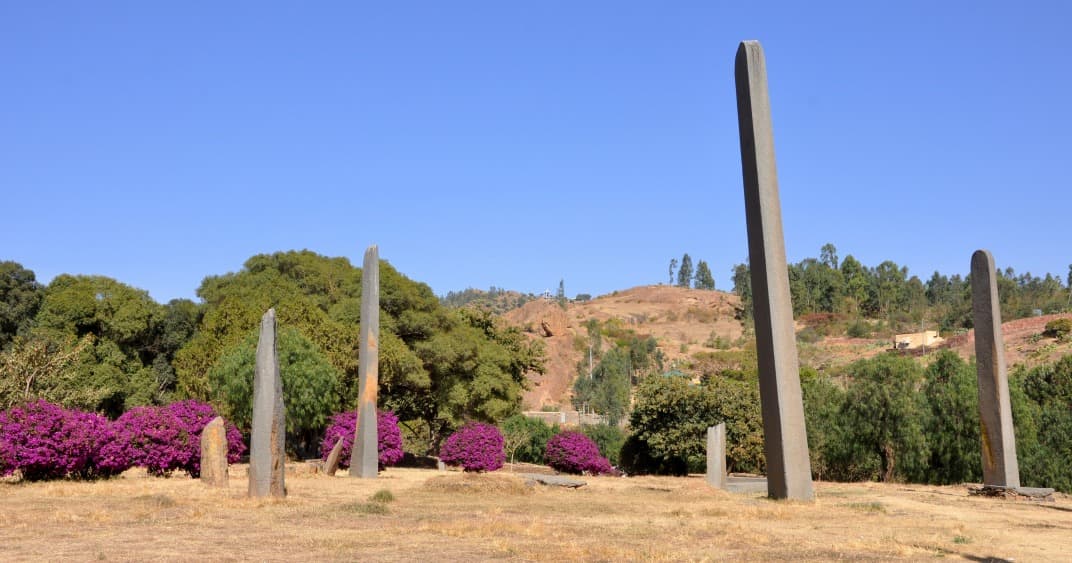
At the heart of Aksum, the granite stelae of the Aksumite kingdom rank among the most imposing funerary monuments of African antiquity. A UNESCO-listed site not to be missed in northern Éthiopie.
At the heart of Aksum, in northern Éthiopie, rise granite obelisks carved more than 1,700 years ago. These monumental stelae marked the tombs of the kings of the Aksum kingdom, one of the great powers of antiquity. Listed as a UNESCO World Heritage site, the field of stelae remains the most visible symbol of a civilization that traded with Rome, Persia, and India.
Practical Information at a Glance
- Admission: paid (group ticket with other archaeological sites in Aksum)
- Recommended duration: 1 to 2 hours for the main field of stelae
- Dress code: no specific dress requirements at the archaeological site
- Access: on foot from Aksum town center, the main field of stelae is in the open air
What You'll See
The northern field of stelae groups together the most imposing monuments. The Great Stele, now collapsed, measured approximately 33 meters—the largest monolith ever erected in antiquity. The Stele of Rome, standing 24 meters tall, was repatriated by Italy in 2008 after being removed by Mussolini in 1937; it now stands once more on its original site.
The stelae are sculpted on their facades to imitate multi-story towers, with doors and windows in relief. Their bases rest on funerary slabs that provide access to underground chambers. A second field of stelae, older and less restored, stands nearby.
History and Context
The Aksum kingdom dominated the Horn of Africa and the southern Arabian Peninsula between the 1st and 7th centuries. Aksum controlled trade routes between the Red Sea and sub-Saharan Africa, exporting ivory, gold, and slaves. The stelae were erected for elites and sovereigns, likely before the kingdom's conversion to Christianity around 330 CE.
After Christianization, the tradition of large funerary stelae ceased. Some stelae still bear inscriptions in Ge'ez, Sabaean, and Greek, testifying to the multilingualism of the Aksumite court.
Highlights of Your Visit
The Repatriated Stele of Rome
Standing 24 meters tall and weighing approximately 160 tons, this stele is the only one still upright among the great monuments. Its facade, sculpted with nine fictional stories, is remarkably preserved. Its repatriation in 2008 was a major diplomatic and cultural event for Éthiopie.
The Great Stele Collapsed
Lying on the ground since antiquity, likely broken during its installation, it allows you to appreciate the true scale of these monuments and the precision of the carving work in the very hard local granite.
The Underground Tombs
Beneath some stelae, stone funerary chambers have been excavated. The Tomb of the False Obelisk and the Brick Tomb are accessible and offer insights into the funerary practices of the Aksumite elite.
The Secondary Field of Stelae
A few hundred meters away, a second set of older, unrestored stelae offers a rawer atmosphere, less frequented by tour groups.
Photography Tips
Morning light, before 9 a.m., is ideal: it illuminates the sculpted facade of the Stele of Rome without backlighting. In late afternoon, raking light brings out the carved reliefs. Bring a wide-angle lens to frame the entire stelae from their bases. No known photography restrictions on the open-air site.
Location and Access
The main field of stelae is located in the center of Aksum, in close proximity to the Cathedral of Saint Mary of Zion. Aksum is accessible by air from Addis Ababa via Aksum Airport (Ethiopian Airlines flights). The town is also connected by road to Adwa and Adigrat. The archaeological sites are grouped within a walkable perimeter from the town center.
Nearby Attractions
- Cathedral of Saint Mary of Zion — a major place of worship for the Éthiopie Orthodox Church, reputed to house the Ark of the Covenant according to tradition.
- Aksum Museum — collections of inscriptions, coins, and Aksumite artifacts that complement your site visit.
- Ruins of the Palace Known as the Queen of Sheba's Palace — remains of a grand Aksumite palace from the 4th century, a few minutes' walk away.
- Royal Tombs of Aksum — an underground funerary complex partially open to visitors, directly linked to the stelae.
Frequently asked questions
The dry season, from October to May, is most favorable. The months of November to February offer pleasant temperatures. Avoid the rainy season (June–September) when access roads can be difficult.
A local guide is not mandatory but highly recommended. The stelae remain silent without historical context, and local guides know the access to underground tombs and details of the inscriptions.
Yes, both sites are within walking distance of each other. A half-day is sufficient for both. Note that access to certain parts of the cathedral is reserved for men.
Photography is allowed at the open-air archaeological site. Inside the underground tombs, check with the on-site guardian, as regulations may vary.
Plan for one to two hours for the main field of stelae and accessible tombs. Including the secondary field and museum, set aside a full half-day.
Ethiopian Airlines operates regular flights between Addis Ababa and Aksum Airport. The flight takes approximately one and a half hours. The road journey is long and often impassable depending on the season.
Interested in this visit?
We can include it in your personalised itinerary.