The historic city of Ankober
The historic city of Ankober
Former capital of the Shewa kingdom perched at 2,465 m, Ankober blends imperial history, an endemic bird species, and steep trails across the central Ethiopian highlands.
The city of Ankober, with some 3,000 inhabitants, sits at 2,465 meters altitude on the central Ethiopian highlands. It is located 140 km northeast of Addis Ababa and 40 km east of Debre Birhan. The city was once known by the name Gorobela, then Ankobar, when it served as the capital of the Shewa kingdom.
Today it is known particularly among ornithologists as the home of an endemic bird species—finches more precisely: the Ankober serin. This small bird, roughly 12 cm in length, is distinguished by its dark brown coloring on its upper body parts and lighter brown or gray on its lower belly.
A second, more unusual distinction belongs to geologists and astronomers. Ankober witnessed the fall of a 6.5 kg "ordinary chondrite" meteorite on July 7, 1942, most likely originating from one of the most widespread asteroids in the main belt separating Mars and Jupiter: "Hebe 6".
History
The city's name change from Gorobela to Ankobar, then Ankober very likely occurred in the early 18th century during the reign of Kidane Kale over the Shewa kingdom (1718–1744). The queen of the Oromo tribes, Anko, reportedly aided the king during this period and gave her name to the future capital of the kingdom.
The Shewa kingdom truly and completely separated from the rest of Abyssinia and present-day Éthiopie in 1786, marking the genesis of the "Era of Princes"—a chaotic period when numerous legitimate and illegitimate noble heirs fought to govern the Abyssinian kingdom. More than 28 princes succeeded one another over half a century, as the Shewa kingdom distanced itself from this grand waltz of crowns.
The first Negus, or king, emblematic and representative of the newly independent Shewa kingdom, Sahle Selassie, reigned over Ankober from 1813 to 1849. During this period, the sovereign made it his priority to control the rebellious Oromo tribes, including that of the former queen Anko, and the Amhara. To do so, he drew closer to the Abichu Oromo, an Oromo sub-tribe, protecting them against the Tulama Oromo.
The king and his people of Ankober and the Shewa kingdom, however, experienced a famine period in 1829, followed by 2 years of cholera that notably killed two-thirds of the royal palace of the capital. After his death in 1849, the Abichu Oromo sub-tribe turned their weapons against his kingdom. The inhabitants of Ankober, however, were able to defend themselves and repel the invaders thanks to the numerous weapons their late sovereign had acquired.
Subsequently, the new emperor of Éthiopie Thewodros II, desiring modernization and reunification of the country's regions, which had been completely decentralized since the beginning of the Era of Princes, retook control of Ankober to rebuild it following numerous attacks from surrounding tribes. At that time, the city's market was full every Saturday.
In 1866, the grandson of Sahle Selassie arrived on the throne of Shewa at Ankober—the most celebrated emperor of the Ethiopian empire, who achieved a decisive victory for the country's independence against the Italians at Adwa in 1896: Menelik II. Negus of the Shewa kingdom from 1855 to 1889, the sovereign took the opportunity to forge ties with Muslim communities in the region and certain French and Italian figures, which greatly helped him ascend to the throne of the Ethiopian empire upon the death of Yohannes IV, Thewodros II's successor, in 1889, despite having no hereditary legitimacy. Menelik II moved the capital of the Shewa kingdom in 1878 from Ankober to Mount Entoto overlooking the future city of Addis Ababa, which he would build around 1886.
Since then, the small city of Ankober has largely lost its former splendor and retreated into the Ethiopian highlands that embrace it. It is accessible only by a single, solitary road that departs from Debre Birhan.
Visiting Ankober Today
Discovering the Heart of the City
In the center of Ankober, the famous open-air market still stands today. It opens on Tuesdays and Saturdays. You can shop there and discover a place that is authentic and quintessentially characteristic of the city. The church of Kidus Mikael, built during the reign of Sahle Selassie, is the last building from the great era of the Shewa kingdom still standing in its entirety. It is worth entering to soak in the history of this city. Do not hesitate to engage a guide to visit the ruins of Menelik II's palace. Only a long wall of stone and mortar remains, but the history told there may captivate many.
A Few Excursions from Ankober
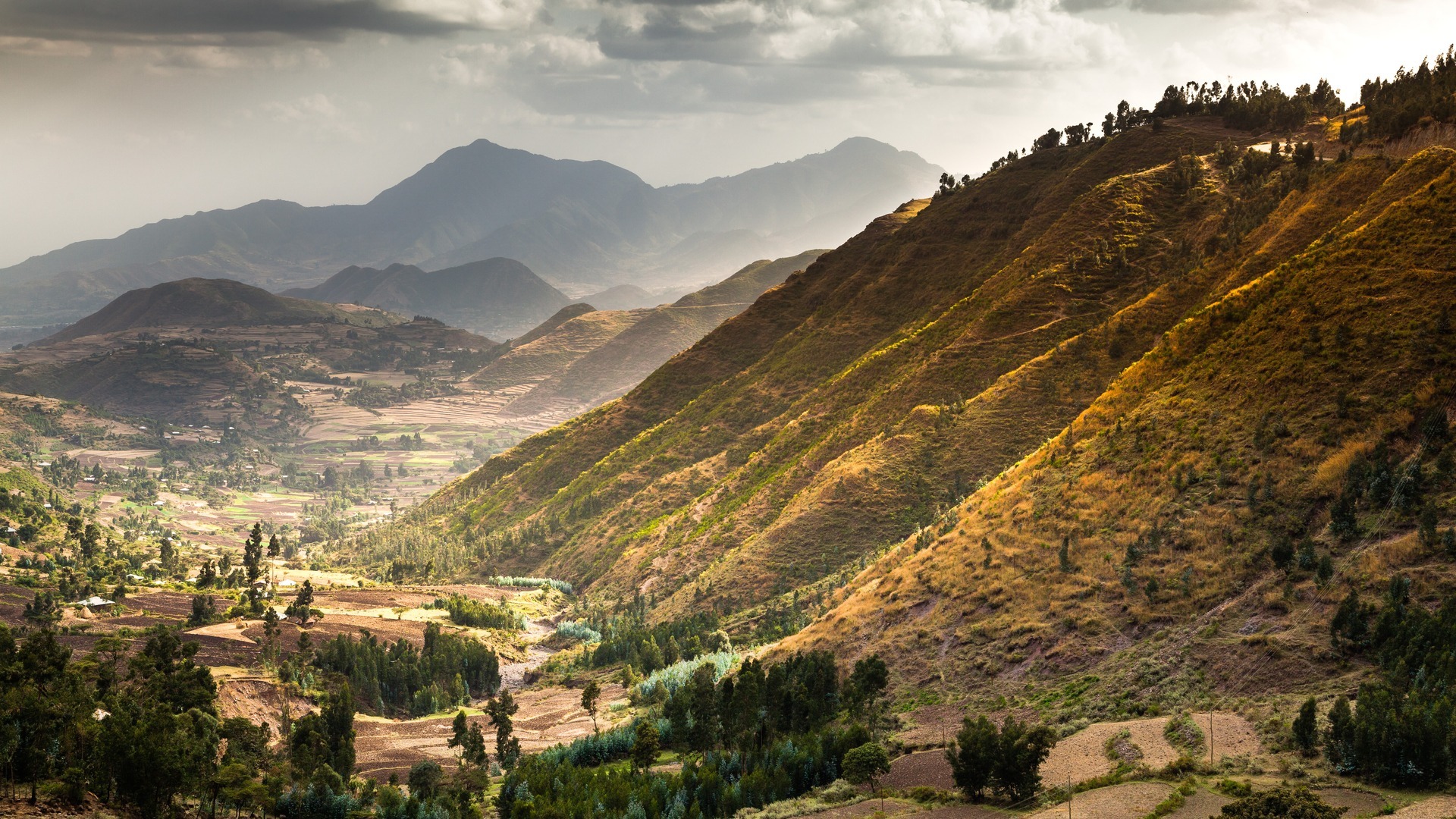
The landscapes around the city of Ankober are splendid. Perched on the Ethiopian highlands, the town offers steep trails that wind through entirely natural areas. Always accompanied by a guide, you can choose to travel on the back of mules to observe the region's fauna. You may spot the famous Ankober serins, or even leopards. Heading north, you will walk through rolling, undulating landscapes covered with grasses and earthen paths. Camping in the area, with your guide's assistance, can be a wonderful experience.
Climate
The best time to enjoy the natural and steep landscapes of the Ankober region is between February and June. Rainfall is rather rare, and temperatures typically range between 17 and 22 degrees Celsius. Avoid the months of July–August, when precipitation doubles in intensity.
The only motorized way to reach Ankober is via the road connecting this city to Debre Birhan, roughly forty kilometers to the west. The journey by car or minibus takes one and a half hours, and the landscapes you encounter during this short trip are breathtaking!
Want to discover this destination?
Our local advisors design your tailor-made trip.