Injera, Ethiopia's Essential Flatbread
A staple of Ethiopian cuisine, injera is a flatbread made from a local grain: teff.
A staple of Ethiopian cuisine, injera is a flatbread made from a local grain: teff. Spread across a platter to hold preparations and sauces on top, it serves as bread, a vessel, and utensil all in one. Discover the injera recipe and everything you need to know to enjoy it as they do in Éthiopie!
What is Injera?
A flatbread made from teff

Injera is a flatbread that ranks among the essential preparations of Ethiopian cuisine. It is prepared from teff seeds, a variety of grain indigenous to the region and cultivated for over 5,000 years, found primarily in high-altitude regions (between 1,800 and 2,500 meters) in Éthiopie and Eritrea.
To make it, teff flour is mixed with water and the dough is left to ferment for several days. Traditionally, cooking takes place on a large circular black clay plate placed over fire, though increasingly Ethiopians use electric hot plates to cook injera.
Good to know:
Different varieties of injera exist throughout Éthiopie and neighboring countries. Teff flour is sometimes replaced by other grains and seeds such as wheat flour, corn, or barley.
The flavors and nutritional benefits of injera
Once cooked, injera forms a thick and spongy flatbread. It has a sour and slightly tart flavor with a hint of nuttiness. As for its nutritional benefits, teff is gluten-free and lactose-free, and rich in fiber, iron, and minerals. It's a highly nutritious grain that sustains the body for a long time.
How is Ethiopian flatbread enjoyed?
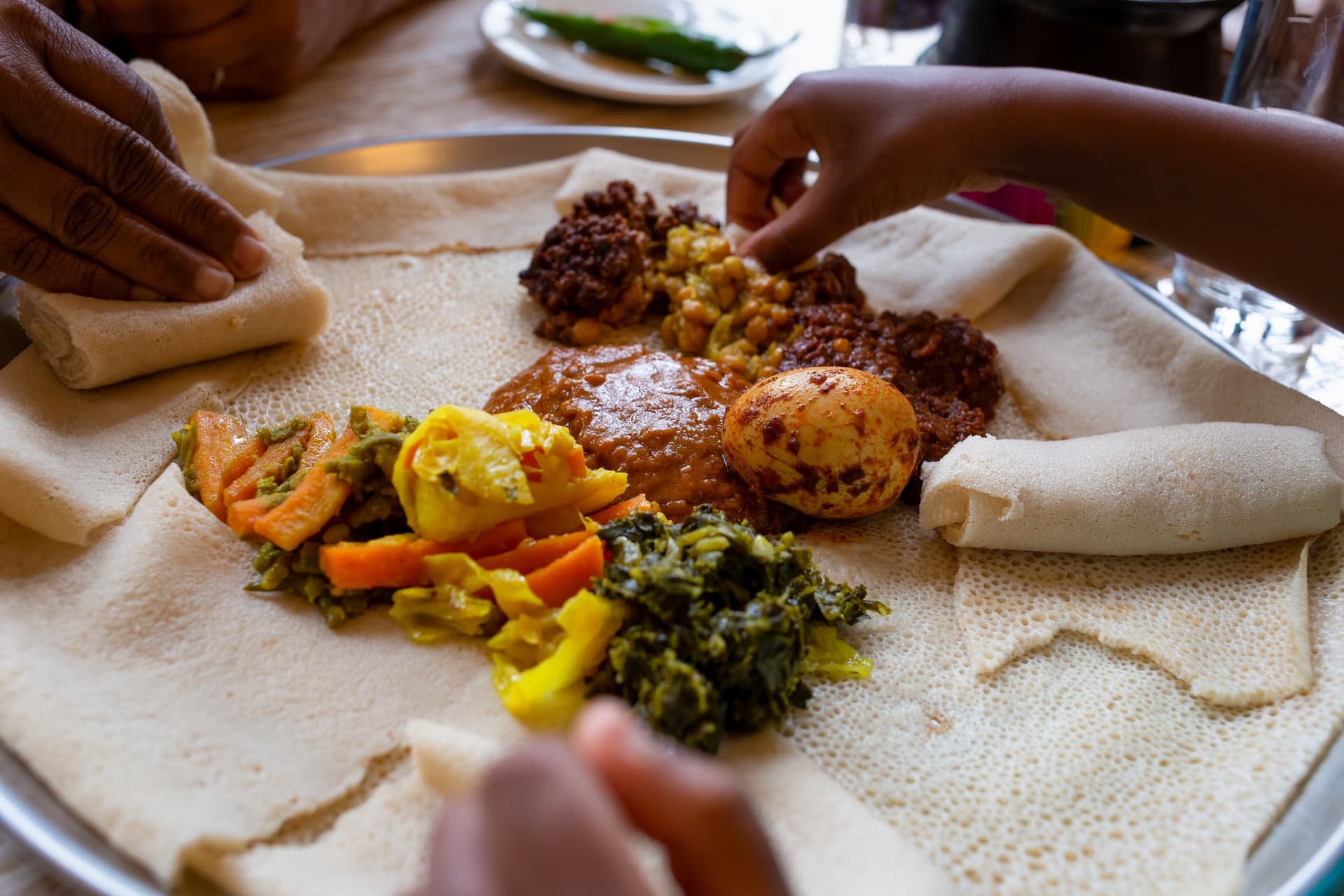
As you've gathered, injera is the staple food in Éthiopie. Indeed, this flatbread accompanies every meal, from breakfast to dinner, and serves as bread, plate, and cutlery. How is this possible? Once cooked, it is spread across a large platter and allows for serving various preparations. These may include meat or vegetable stews (called "Wat") and various sauces.
Among the most common preparations used to garnish Ethiopian injeras, you'll find:
Shiro: a vegetarian stew made from chickpea flour and local spices;
Atkilt wot: a mix of sautéed carrots, potatoes, and cabbage;
Mesir wot: a lentil mix accompanied by berbère sauce (with Ethiopian spices);
Fasolia: a mix of green beans, carrots, and caramelized onions;
Tibs: sautéed lamb, beef, or mutton accompanied by onions;
Doro wot: a spiced chicken and egg stew;
Kefto: raw ground beef massaged with niter kibbeh (clarified butter infused with herbs and spices) and marinated in mitmita (a spice blend based on red chili powder).
To enjoy injera and its preparations, Ethiopians tear off small pieces of flatbread with their right hand to grasp the sauces and food. Once all the preparations and sauces are finished, only the remaining pieces of injera, which have absorbed the sauces and juices, remain.
This is why injera is considered a plate, a fork, and bread all in one.
Did you know?
In Éthiopie, people eat with their hands and use the right hand for religious reasons. Sharing a meal with loved ones allows locals to have a good time, but above all strengthens bonds. Note that it is considered impolite to lick your fingers. You may wash your hands at the end of the meal.
The authentic Ethiopian injera recipe

Ingredients for 4 flatbreads:
200 g teff flour,
1 packet baker's yeast (or starter),
400 ml warm water,
1 pinch of salt,
1 pinch of baking soda.
Preparing injera:
Step 1: Preparing the dough
Start by dissolving the yeast in a little water. In a non-metallic bowl, mix the teff flour and gradually incorporate the water. Add the yeast, salt, and baking soda. Mix and knead until you obtain a homogeneous, smooth, and supple dough.
Step 2: Fermentation
Cover the bowl with a clean kitchen cloth and let the dough rest for 3 days at room temperature to ferment. After this time, you'll notice that water has accumulated on the surface. Pour off the water and proceed to cooking!
Step 3: Cooking
Thin out the dough with warm water until it reaches the consistency of a crêpe batter. Heat a non-stick skillet over medium heat without any fat. Pour a little batter to coat the bottom of the skillet. Reduce heat and let cook for 30 seconds.
Once bubbles appear, you can cover the skillet and continue cooking for 15 seconds. You can remove the flatbread when it pulls away from the edges. Simply repeat the process with the remaining batter.
The trick to remember:
The top surface of injera should have a spongy and porous appearance, which will make it easier to hold the sauces and foods placed on top. The bottom surface should remain perfectly smooth. This is why you should never flip the flatbread during cooking!
Cooking injera is the trickiest step, but with patience and practice, you'll achieve the perfect texture!
Step 4: Plating
All that's left is to plate by arranging the different preparations on top of the flatbreads.
Enjoy your meal!
Little known throughout the world, Ethiopian cuisine deserves to be talked about more often. And for good reason—it's renowned for its countless flavors thanks to the use of numerous spices. Proof lies in all the essential culinary specialties of Éthiopie. It's also a cuisine that will please everyone: meat lovers and vegetarians alike, adults and children! So what are you waiting for to try it?
Frequently asked questions
Injera is a thick and spongy fermented flatbread, a staple of Ethiopian cuisine. It is prepared from teff flour, a grain indigenous to the region and cultivated in Éthiopie for over 5,000 years. It serves simultaneously as bread, a plate, and utensil during meals.
Teff flour is primarily found in health food stores and specialty shops specializing in African or dietary foods. It's also available from numerous online retailers. Verify that it's whole teff for authentic flavor.
Yes, it is possible to partially replace teff flour with wheat, barley, or corn flour. These variations are actually common in certain regions of Éthiopie. However, the characteristic sour flavor and spongy texture of injera will be slightly different.
Preparing injera requires approximately 3 days of fermentation to develop its characteristic sour flavor. Cooking itself is quick: allow about 45 seconds per flatbread. Plan to start preparation 3 days before you want to enjoy it.
Yes, traditional injera made from teff is naturally gluten-free, as teff is a grain containing no gluten. Be careful, however, with variants made from wheat or barley flour, which are unsuitable for people with gluten intolerance.
Injera keeps at room temperature for 1 to 2 days, wrapped in a clean cloth. In the refrigerator, it can be kept for up to 4 days. It is also possible to freeze it by separating each flatbread with parchment paper to prevent them from sticking together.