Danakil
Danakil
In northeastern Éthiopie, the Danakil concentrates active volcanoes, salt lakes and acidic hydrothermal springs in one of the most extreme environments on the planet.
The Danakil desert, in the Afar region of northeastern Éthiopie, is one of the most extreme environments on the planet. Located at the junction of three tectonic plates at the heart of the East African Rift, it spans more than 4,000 km² and descends to 125 meters below sea level. Active volcanoes, salt lakes, acidic hydrothermal springs and camel caravans make up a landscape shaped by tectonics and heat.
Why visit Danakil
Few regions in the world concentrate so many rare geological phenomena over such a restricted area. Danakil offers the opportunity to observe a permanent lava lake, multicolored hydrothermal deposits, salt expanses exploited for centuries, and the way of life of a nomadic people adapted to some of the globe's harshest climatic conditions. It is also a land of paleoanthropology: it was in the Afar region that the skeleton of Lucy, a hominid over 3 million years old, was unearthed in 1974.
For Earth sciences as well as planetology, Danakil serves as a natural laboratory: the extremophile microbial life identified in the hypersaline environments of Dallol is studied as a possible analogue of Martian environments.
What to see in Danakil
Erta Alé volcano
"The smoking mountain" in the Afar language rises to approximately 600 meters and houses one of the world's few quasi-permanently active lava lakes. The lava lake level fluctuates greatly with eruptive cycles. The ascent takes place at night to avoid the heat and enjoy the spectacle of glowing flows. Allow several hours of hiking and supervision by local guides, including armed escort depending on the security context.
Dallol and its hydrothermal springs
The Dallol site features deposits of salt, potash, iron oxide and sulfur forming a patchwork of orange, yellow and red hues, dotted with acidic blue pools and white fumaroles. Sulfurous emissions and soil instability require strictly following guide instructions. Access is by 4x4 from the region's lodging bases.
Karoum and Afrera salt lakes
Lake Karoum (Assale) has been exploited for centuries: workers cut rectangular salt plates with adzes that are later transported by camel. Lake Afrera, further south, operates on the principle of salt marshes where salt is harvested through evaporation. This salt is reputed to be purer than that from Karoum.
Salt caravans
Long processions of camels laden with rectangular plates are the iconic image of the region. Danakil salt long served as a medium of exchange in regional trade; it continues to be transported to highland markets along ancestral routes.
Adapted wildlife
- African wild ass
- Soemmering's gazelle
- Grevy's zebra
A few species of lizards, scorpions and birds complete a restricted yet remarkably drought-adapted fauna.
History and Afar people
Danakil is inhabited by the Afar people, nomadic herders who move according to water sources and pastures with their herds of goats, sheep, donkeys and camels. They speak Afar, are predominantly Muslim, and have preserved a clan organization and strong attachment to their territory.
Artisanal salt extraction, practiced according to techniques passed down through generations, still structures a part of the local economy today. Salt long served as currency in the region.
From a scientific standpoint, the Afar depression is one of the major sites for understanding human evolution: the discovery of Lucy in 1974 made the region a reference point in paleoanthropology.
Practical advice
- Good physical condition required: hiking in rough terrain, temperatures reaching 50°C in summer.
- Equipment: closed hiking shoes, light and covering clothing, sunglasses, mask or scarf for fumaroles, headlamp for Erta Alé.
- Hydration: plan for several liters of water per day; agencies typically provide supplies.
- Security: the border zone requires passage through an approved agency with guides and escort according to local directives.
- Basic accommodation on-site: nights under the stars or in rudimentary camps.
- Respect Afar customs: ask before photographing, appropriate dress code.
When to visit
The most practicable season extends from November to February, when temperatures, though high, remain tolerable (often 30 to 35°C during the day). From March to October, heat regularly exceeds 45°C and makes excursions grueling, particularly the Erta Alé ascent. Rainfall is extremely rare throughout the year.
How to get there
By plane
Access is via Bole International Airport in Addis Ababa, followed by a domestic flight to Mekelle (historic circuit departure point) or Semera, the Afar region's capital.
By organized tour
Tours are almost exclusively by 4x4 over several days, led by a local agency. An Afar guide and, depending on the situation, an armed escort accompany groups. Itineraries typically combine Erta Alé, Dallol and a salt lake.
Nearby
Danakil lends itself well to a broader circuit in northern Éthiopie. From Mekelle, travelers often continue toward the rock-hewn churches of Tigray and historic highlands.
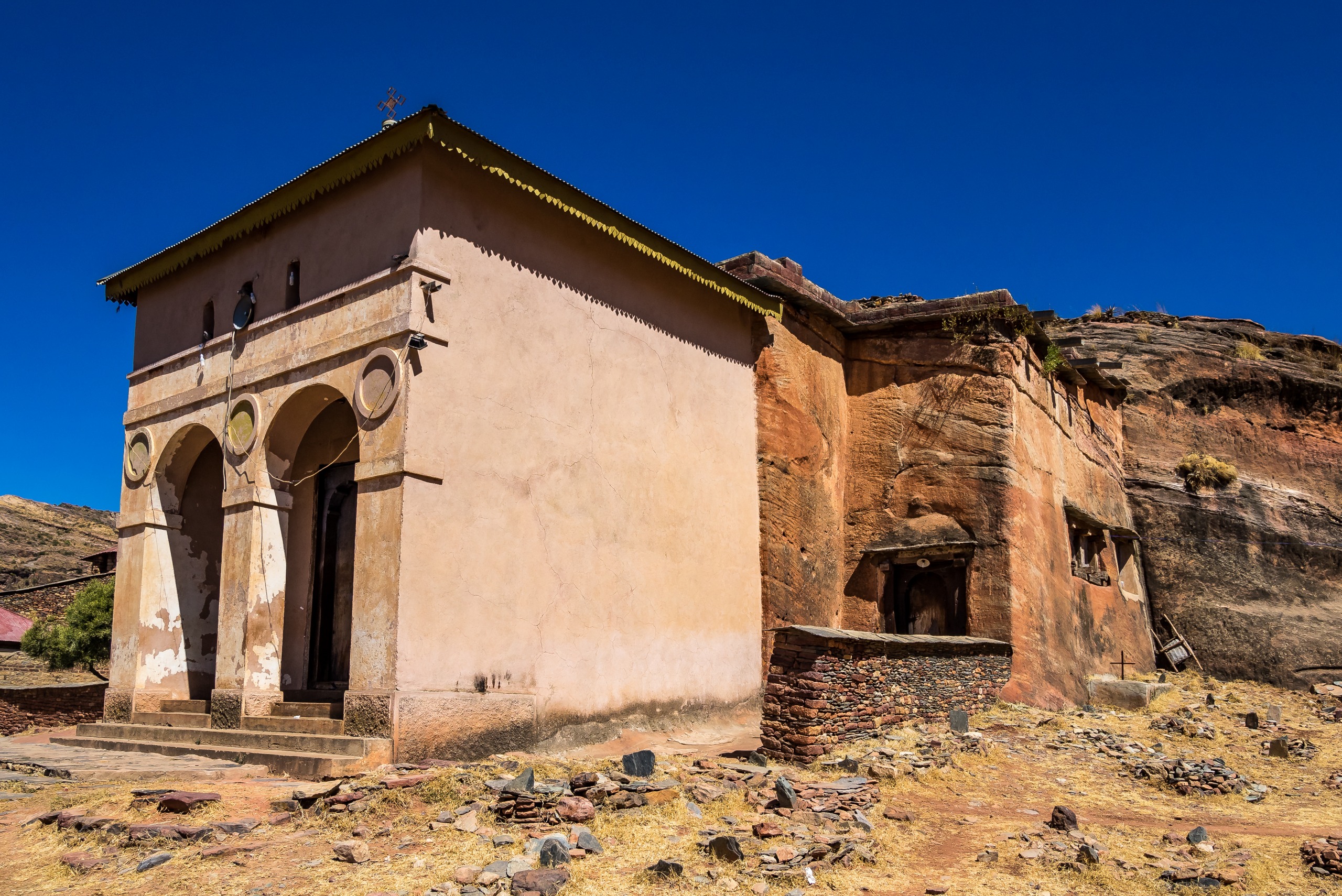
- Abreha Atsbeha Church, one of Tigray's major rock-hewn churches.
- Fasilidas Castle in Gondar, a key stop in Éthiopie's imperial history.
- Debre Birhan Selassie Church and its murals.
Frequently asked questions
Frequently asked questions
Most tours last 3 to 4 days from Mekelle, the minimum time to combine Erta Alé, Dallol and the salt lakes.
The region presents risks related to heat, toxic emissions from Dallol and the border security situation. Passage through an approved agency with guide and escort is mandatory for most itineraries.
Technically yes, but lava lake activity varies according to eruptive cycles and access may be restricted. The period from November to February remains most favorable.
Yes, a visa is required for most nationalities. It can be obtained online (e-visa) before departure.
Accommodation is basic: simple camps, beds in the open air on wooden platforms, overnight at the top of Erta Alé after the ascent.
Plan your trip
Danakil fits into a northern Éthiopie circuit combining volcanoes, historic sites and encounters with highland peoples. To build a custom itinerary, consult our Éthiopie travel suggestions.
Interested in this visit?
We can include it in your personalised itinerary.