Abreha Atsbeha Church
Abreha Atsbeha Church
Semi-monolithic sanctuary in Tigré, 15 km from Wukro. Ancient frescoes, royal tombs and active pilgrimage at a major site of Ethiopian Orthodox Christianity.
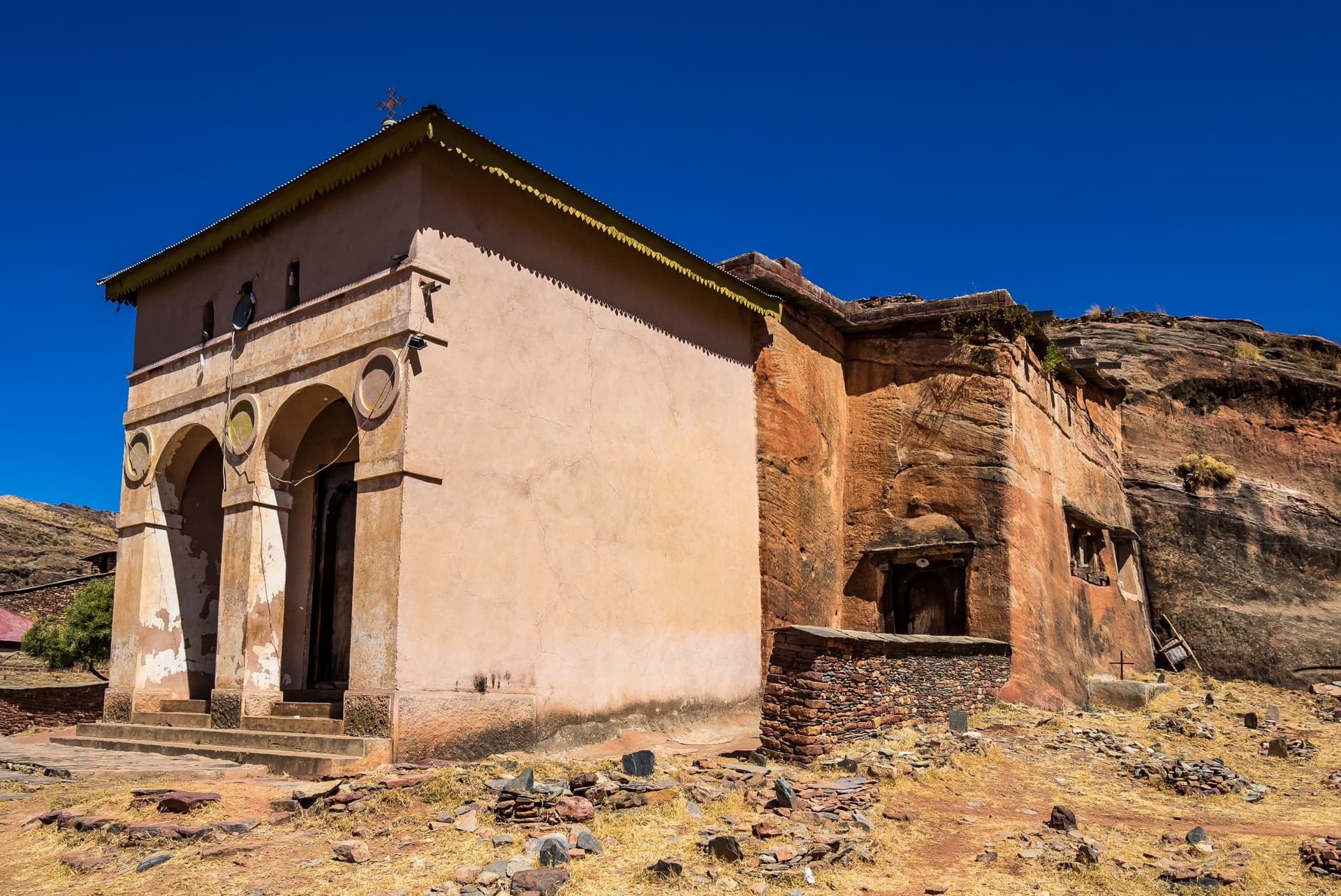
Abreha Atsbeha Church is located in the Tigré region, approximately 15 km from Wukro and at 2,200 m altitude. Semi-monolithic — partly hewn from rock, partly constructed — it ranks among Éthiopie's oldest Christian sanctuaries. Its cruciform interior, medieval frescoes and role as an active pilgrimage site make it a landmark destination for those interested in Ethiopian Orthodox Christianity.
Why visit Abreha Atsbeha
Three main reasons warrant a stop at this church:
- Rare rock-cut architecture: semi-monolithic structure with a portico added later, cross-shaped interior, elaborate ceiling, decorated pillars and vaults.
- A collection of ancient frescoes with natural pigments, traditionally dated to the 10th-12th centuries (dating still debated among historians), depicting biblical scenes and local figures.
- A living place of worship, frequented year-round and especially during the major pilgrimage on October 14, which attracts thousands of the faithful.
The site remains less well-known than churches on the northern circuit or Lalibela, but visitation is steadily increasing.
History and tradition
The church's name honors two twin kings of the Axumite kingdom, Abreha and Atsbeha, sometimes identified in chronicles with the sovereigns Ezana and Sayzana. Ethiopian tradition credits them with introducing Christianity as the state religion in the 4th century, under the influence of Syrian missionaries — the historicity of their joint reign remains debated by modern scholars.
According to the same tradition, the church was founded between 335 and 340 CE. This dating is legendary rather than archaeologically established, but it places the sanctuary at the heart of the foundational narrative of the Ethiopian Orthodox Church.
The structure bears traces of a fire that tradition attributes to the Jewish queen Gudit (also called Judith or Yodit), who allegedly attempted to destroy the site before falling suddenly ill upon entering it. The ceiling, blackened by soot, remains visible today. In the 19th century, the vestibule was remodeled under Emperor Yohannes IV, whose fresco shows him on horseback departing to fight the Egyptians, accompanied by clergy.
What you observe on site
The interior architecture
The cross plan is supported by massive pillars and covered with ornate vaults. The exterior portico, later than the main structure, provides access to a space whose simplicity contrasts with the richness of painted decoration.
The frescoes
The walls bear representations of the Virgin Mary, Christ, angels, apostles and Ethiopian saints. One scene depicts Abreha and Atsbeha holding crosses and scepters, referencing their role in Christianization. Natural pigments have retained notable vibrancy. Most of the works date to the 10th-12th centuries, though some historians propose later dating for retouched panels.
The Holy of Holies and museum
The mummified bodies of the two brother-kings rest in the Holy of Holies. According to accounts passed down by priests, a cleric who attempted to open the tomb had his hands burned by supernatural fire — an anecdote rooted in local oral tradition. A small adjacent museum houses ancient manuscripts and liturgical objects; it opens only on request to the priest, in exchange for a donation.
The blessed water spring
A few hundred meters to the northeast, a spring is venerated as blessed water. Legend recounts that King Ezana struck the rock to quench the thirst of the builders. The faithful believe that drinking this water beautifies the voice, echoing that of Saint Yared, a great Ethiopian liturgical composer.
Practical information
- Dress code: shoulders and knees covered, scarf appreciated for women. Shoes to be removed at the entrance.
- Hours: open during the day, with possible breaks during office hours. Better to arrive in the morning.
- Admission: modest entry fee, paid on site. Additional donation expected for museum access and priest's explanations.
- Photography: generally tolerated indoors without flash; confirm with the caretaker.
- Visit duration: allow 1 to 1.5 hours on site, longer if you head down to the spring.
When to go
The dry season, October to May, offers the most stable conditions for reaching the site. Three periods concentrate religious activity:
- October 14: annual pilgrimage, thousands of the faithful converge on the church.
- Genna (Ethiopian Christmas, January 7): nocturnal celebrations and sung liturgies.
- Timkat (Epiphany, January 19): processions and water blessings.
These dates offer an intense immersion, but the site is then very crowded. Outside festivals, the atmosphere is more contemplative.
How to get there
The usual starting point is Mekele, capital of Tigré, connected to Addis Ababa by air.
- Car with driver: the most practical option. Allow approximately 1 hour from Mekele to Wukro, then a short additional journey to the church.
- Minibus: regular and economical connections between Mekele and Wukro, then local taxi or bajaj for the final kilometers.
- Guided hike: some operators offer a walking approach through the Tigré countryside, with a local guide providing historical and religious context.
Important note: recent conflicts in Tigré have affected access to and conservation of the site. Check the security situation before traveling and favor a well-informed local operator.
Nearby attractions
The Tigré region concentrates several rock-cut churches and historical sites:
- Wukro Cherkos, another semi-monolithic church located in the town itself.
- The Gheralta plateau and its cliff-cut churches, further north.
- The Danakil Depression, several hours' drive away, for those extending toward volcanic landscapes.
- Fasilidas Castle in Gondar, a classic stop on the northern historical circuit.
Frequently asked questions
Frequently asked questions
Yes, the site welcomes visitors of all faiths outside times reserved for the faithful. Modest clothing and respect for the priest's instructions are expected.
Not mandatory, but highly recommended. The priest or a local guide explains the frescoes, opens the museum on request and shares stories linked to the site, few of which are signposted on-site.
Allow 1 to 1.5 hours for the church and museum, and add 30 to 45 minutes if you wish to reach the blessed water spring.
Yes, both sites often feature in northern historical circuits, but they are far apart. Plan several days and significant travel time by air or road to connect Tigré to Lalibela.
Extend your visit
Abreha Atsbeha naturally fits into an itinerary combining religious heritage and Ethiopian landscapes. To plan a stay combining Tigré, highlands and the Omo Valley, consult our Éthiopie journeys designed with local partners.
Interested in this visit?
We can include it in your personalised itinerary.