Debre Birhan Selassie Church
Debre Birhan Selassie Church
In Gondar, Debre Birhan Selassie Church preserves a painted ceiling with 135 cherubs and an enclosure wall with 12 symbolic towers. Visit guide.
Perched on a hilltop northeast of Gondar, Debre Birhan Selassie Church is one of the best-preserved religious buildings in northern Éthiopie. Its name means "mount of the light of the Trinity." It is celebrated for its 19th-century murals, its ceiling covered with angel faces, and its survival of the sacking of Gondar in 1888.
Why visit Debre Birhan Selassie
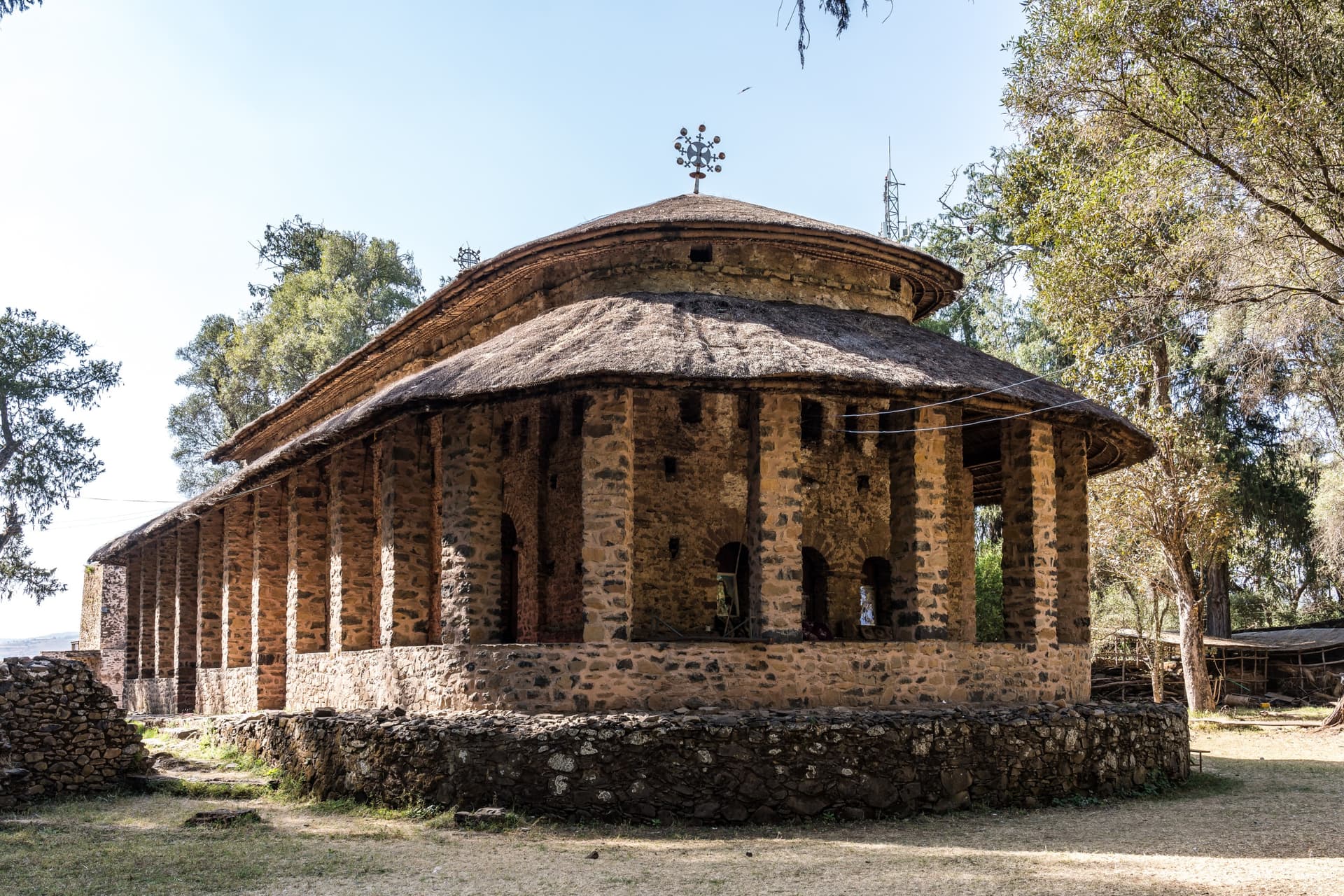
The church concentrates several points of interest in a single location: testimony to Gondarien architectural style (two-level thatched roof, rectangular plan), a painted program of rare density in Orthodox Éthiopie, and a history marked by invasions and legend. Unlike other Gondar sanctuaries, which were burned in 1888, this one remained standing. Visitor numbers remain moderate and the visit, brief (allow 45 minutes to 1 hour), fits easily into a tour around the imperial city.
History of the church
The current building dates to the great Gondarien period, when Ethiopian emperors endowed their capital with churches and palaces. Local tradition attributes its construction to the reign of Eyasu (Iyasu), between the late 17th and late 18th centuries according to sources — the dating oscillates between Iyasu I (Eyasu the Great, late 17th century) and Eyasu II (mid-18th century), a point still debated by historians.
Before the rectangular church seen today, a first central-plan sanctuary measuring approximately 30 meters in diameter stood on the site. According to tradition, it was destroyed by lightning. Its foundations are still visible along the north and south sides of the current building.
In 1888, Mahdist Dervishes from Sudan sacked Gondar and burned all its churches. Debre Birhan Selassie alone was spared. Tradition recounts that a swarm of bees appeared to drive back the attackers and that the archangel Michael stood at the main door, a flaming sword in hand. The episode reinforced the site's sacred aura, which remains a major pilgrimage destination.
In 1979, Gondar and its monumental complexes, including Debre Birhan Selassie, were inscribed on the UNESCO World Heritage List. The frescoes have since undergone a restoration program under UNESCO's aegis.
What to see on site
The enclosure and twelve towers
The site is surrounded by a stone wall pierced with arched wooden doors. Twelve circular towers symbolize the apostles. A thirteenth, taller tower, evokes the Lion of Judah, emblem of the Solomonic dynasty. The lion's tail is carved above the west door, and its impression can be discerned in the upper part of the tower for attentive visitors.
The building's architecture
The church measures 27 meters long by 7.40 meters wide. A covered ambulatory of 2.30 meters surrounds the sanctuary. On the west side, a narthex of 10.30 meters opens access to the place of worship; it is the only space fitted with windows. To the east, the sanctuary called "Maqdas" is reserved for priests and houses the tabernacle.
The frescoes and ceiling with 135 cherubs
The interior paintings, dated between 1815 and 1825, cover the walls and ceiling. Tradition attributes them to Haile Meskel, but research contests this attribution. The ceiling is the most recognizable element: 135 cherub faces painted in regular rows, with large expressive eyes, gaze down at visitors. Thirteen of them have been erased by water infiltration.
On the walls, biblical scenes can be identified, along with Ethiopian Orthodox saints (including Saint George, patron of the country) and the Trinity. Behind the tabernacle, a vast representation of hell lines up the devil, grinning demons, and tortured sinners. Above the altar, a striking Crucifixion dominates the sanctuary. On the second-floor gallery, curtained windows allowed Emperor Eyasu II and his mother to attend services away from view.
When to visit
The church can be visited year-round. The dry season, from October to May, is the most comfortable for getting around Gondar and enjoying the light on the frescoes. Two highlights of the Orthodox calendar are worth targeting: Meskel (late September, feast of the invention of the True Cross) and especially Timkat (mid-January, Ethiopian Epiphany), which features major celebrations in Gondar. Crowds increase then, but the liturgical atmosphere is exceptional.
How to get there
The church is located approximately 2 to 3 km from central Gondar, on a hilltop northeast of the city.
- By bajaj (tuk-tuk): the most practical and economical means. Drivers know the site; the trip takes just a few minutes.
- By taxi: a slightly more comfortable option, negotiable as a round trip with waiting time on site.
- On foot: allow 30 to 45 minutes from the center, on a slightly sloping path. Wear suitable shoes and bring water.
Practical information
- Hours: open in the morning and afternoon with a midday break. Verify on site, as schedules may vary.
- Entry fee: paid admission in Ethiopian birr, cash only. Revenues contribute to conservation. A donation to the priests is appreciated if you benefit from a guided tour.
- Dress code: shoulders and legs must be covered.
- Shoes: must be removed before entering the church.
- Access: main door for men, side door for women, in accordance with Orthodox custom.
- Photography: permitted outside, sometimes restricted inside to preserve the frescoes.
Around Gondar
Debre Birhan Selassie is part of a complementary set of attractions:
- Fasilidas Castle and the royal enclosure (Fasil Ghebbi), in the heart of Gondar.
- Lake Tana and the sources of the Blue Nile, approximately 180 km to the south, accessible from Bahir Dar.
- The rock-hewn church of Abreha Atsbeha, in Tigray, to continue exploring Ethiopian Christian art.
Frequently asked questions
Frequently asked questions
Allow 45 minutes to 1 hour on site, more if you attend a service or take time to walk around the enclosure with its twelve towers.
Yes, services are regularly held in the church. Visitors may attend provided they respect the dress code, maintain silence, and follow access rules. The most notable celebrations take place during Timkat and Meskel.
The 12 circular towers of the enclosure wall symbolize the twelve apostles. The thirteenth, taller one, represents the Lion of Judah, emblem of the Ethiopian imperial dynasty. Its tail is carved above the west door.
The current paintings were executed between 1815 and 1825. Tradition attributes them to artist Haile Meskel, an attribution contested by scholarship. They have been restored under UNESCO's aegis.
Yes, in accordance with the custom of the Ethiopian Orthodox Church: men use the main door, women use the side door. Inside, the faithful also stand on either side.
Plan your trip
Debre Birhan Selassie fits into a classic itinerary of northern Éthiopie, between Gondar, Lalibela, Tigray, and Lake Tana. To build a custom itinerary including Gondar and its churches, consult our trips to Éthiopie.
Interested in this visit?
We can include it in your personalised itinerary.