Mursi
Mursi
A semi-nomadic ethnic group in southern Ethiopia, the Mursis live along the Omo River. Practical guide: lip plates, Donga, access from Jinka and ethical visiting considerations.
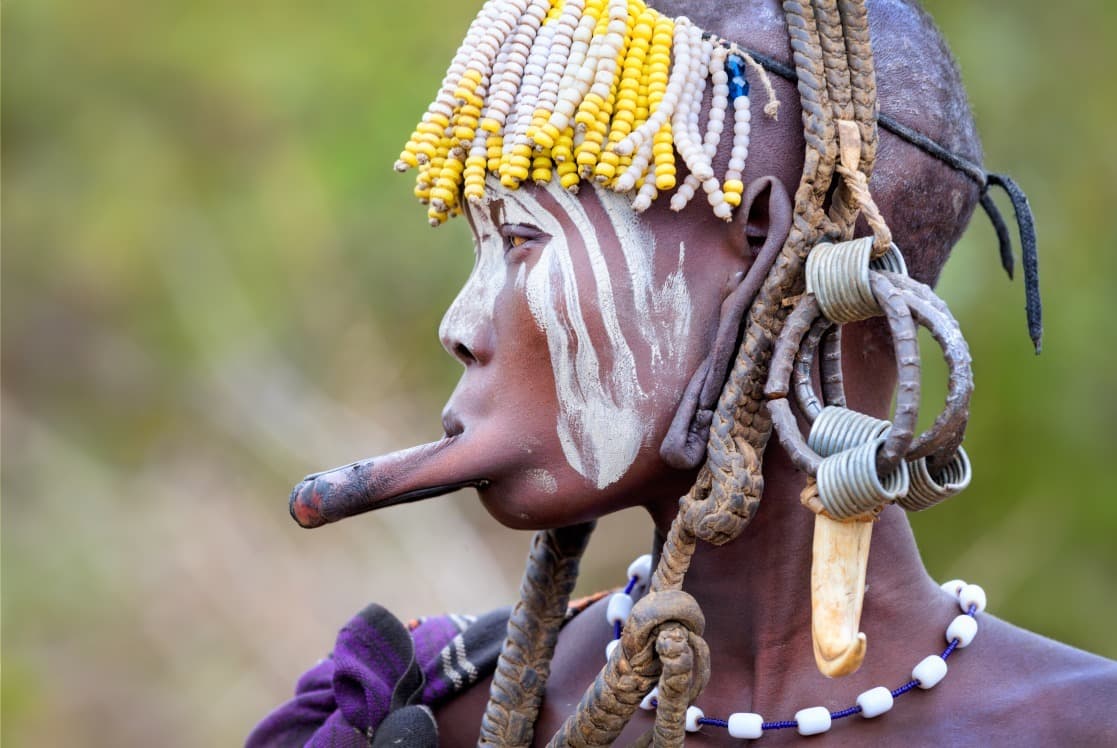
The Mursis form a semi-nomadic ethnic group living in southern Ethiopia, on the western periphery of the Mago National Park, along the Omo River. This population, estimated at fewer than 10,000 individuals, is known for the lip ornaments worn by women (the famous lip plates or clay discs) and for their initiation rituals still practised today. An encounter with them often represents a highlight of a journey through the Omo Valley, provided the visit is approached with respect and careful preparation.
Why meet the Mursis
- Observe a pastoral culture that has preserved the essence of its traditions despite external pressures.
- Understand the social role of the lip plate, a labial ornament still worn by some Mursi women.
- Explore the world of the Donga, a ritual tournament reserved for young men.
- Combine your visit with a safari in Mago National Park (savanna, escarpments, wildlife).
History and territory
The Mursis have long occupied the forested and savanna areas west of Mago National Park, along the Omo River. They share these lands with several neighbours: Bodis, Surmas, Anuaks and Nuers. Relations are tense with the Hamers and Bodis, primarily due to conflicts over cattle theft and, historically, raids for women.
Their economy is based on pastoralism. The tsetse fly and the sleeping sickness it transmits weigh heavily on their movements: cattle are only driven to the river to drink out of strict necessity, a pattern that structures their entire pastoral calendar.
The Mursis speak a language of the Nilotic family, also called Mursi. An interpreter, generally arranged from Jinka, is necessary for any in-depth conversation.
According to the 2007 Ethiopian census, 7,483 people identified as Mursi out of a national population of approximately 73.75 million. Current estimates place their numbers at fewer than 10,000 individuals.
What you can see and understand on the ground
The lip plate ritual
Wearing a lip disc involves a lengthy initiation process for young girls. Sources vary on the exact age of entry into the ritual (between 10 and 18 years depending on the village):
- extraction of the lower incisors;
- perforation of the lower lip and insertion of a wooden peg;
- progressive enlargement of the opening through cylinders of increasing size;
- final placement of an engraved clay disc, sometimes removed daily.
The lip plate is not merely an ornament: it is embedded in a complex social system where status, codified beauty and the community's history intertwine. It is worth noting that similar lip practices are found among neighbouring Surmas; the idea of an exclusively Mursi practice thus deserves to be nuanced.
The Donga
The Donga is a stick-fighting tournament held at the end of the rainy season, around September. It pits young men of marriageable age against one another. The duels demand agility, strength and control: the goal is to dominate your rival without killing him. The winner of the overall competition is carried in triumph; a young woman from the crowd may then choose him as her husband. The organisation of the Donga remains dependent on seasonal patterns and agreements between clans: attendance is not guaranteed, even in September.
Mago National Park
A visit to Mursi villages naturally combines with an excursion into Mago National Park: safaris in the savanna, climbing Mount Mago, guided camping. The wildlife is less dense than in the major East African parks, but the scenery and isolation are part of the experience.
When to go
The months of July and August correspond to the rainy season: the tracks become nearly impassable, even in a 4x4. The rest of the year is generally passable, with particular mention for September, a period favourable for the Donga, and the dry season (November to February) when travel is most comfortable.
How to reach the Mursis
- Domestic flight from Addis Ababa to Jinka, the main town in the region.
- Rent a 4x4 with driver from Jinka, as the terrain requires it.
- Drive towards Mago National Park, then on tracks to one of the Mursi villages.
The round trip from Jinka typically takes a full day. An English-speaking local guide and a park scout are mandatory to enter the villages.
Practical information and ethical visiting guidelines
- Duration: plan for 1 to 2 hours on site, allowing time to exchange through an interpreter and walk around the village.
- Fees: park entry, village visit fee, interpreter and scout compensation. Amounts vary; inquire in Jinka before departure.
- Photography: each photo is negotiated individually with the person being photographed, for a small fee. Always ask permission before shooting, especially with children.
- Clothing: covered clothing, closed shoes, water and sun protection are essential.
- Health: antimalarial prophylaxis recommended, vaccinations up to date (yellow fever particularly important).
Nearby
The Omo Valley is home to other ethnic groups with distinct cultures (Hamers, Karos, Banna, Dassanech), often included in the same itinerary. Further north and east, Ethiopia offers very different landscapes:
- the Danakil depression, one of the hottest regions on the planet;
- the Erta Ale volcano and Dallol site;
- the Menagesha national forest, near Addis Ababa;
- Fasilidas Castle in Gondar;
- and, for wildlife enthusiasts, the Ethiopian wolf.
Frequently asked questions
Frequently asked questions
Plan your journey
A meeting with the Mursis fits into a broader itinerary that combines the Omo Valley, the highlands and sometimes the Danakil. To build a coherent and ethical route, explore our Ethiopia travel ideas.
Interested in this visit?
We can include it in your personalised itinerary.