Historic North
The cradle of Christian Éthiopie on the high plateau: rock-hewn churches of Lalibela, castles of Gondar, monasteries of Lake Tana, between 1,800 and 3,000 meters.
The Historic North stretches across a volcanic plateau that rises between 1,800 and 4,500 meters, from the shores of Lake Tana to the escarpments of Tigray. Here, on these temperate highlands, the identity of Christian Éthiopie was forged since the Kingdom of Aksum in the fourth century. The landscapes alternate between grain plateaus where teff (the cereal for injera bread) ripens, deep gorges carved by the Blue Nile and its tributaries, and basalt ridges sculpted by erosion. Altitude sets the rhythm: days are dry and luminous between November and March, nights regularly drop below 8°C in Gondar or Lalibela.
The classic itinerary begins in Bahir Dar, a lakeside town on the southern shore of Lake Tana, the country's largest freshwater body (3,600 km²). Some twenty Orthodox monasteries occupy its islands and peninsulas, including Ura Kidane Mehret on the Zege peninsula, known for its frescoes painted on canvas. Thirty kilometers to the southeast, the Tis Issat falls mark the start of the Blue Nile toward Sudan; their flow is now reduced by the upstream dam, but remains substantial during the rainy season. An asphalt road of 180 kilometers then leads to Gondar, the former imperial capital founded in 1636 by Fasilides.
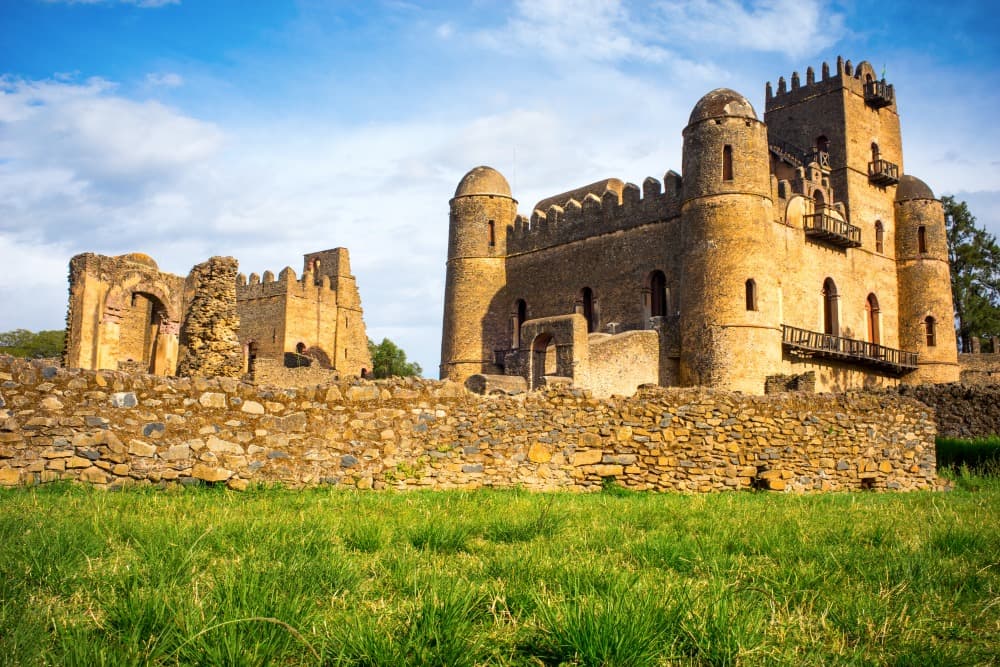
Gondar surprises with its fortified complex of stone castles, the Fasil Ghebbi, a UNESCO World Heritage site. Six successive sovereigns built their palaces here over two centuries, in a style that blends Portuguese, Indian, and Axumite influences. A few kilometers from the city, the Church of Debre Berhan Selassie preserves a ceiling covered with eighty angel faces, an emblematic image of Ethiopian religious art. Gondar hosts the Timkat festival in January (Orthodox Epiphany), three days of processions around the pool of Fasilides where thousands of worshippers bathe at dawn.
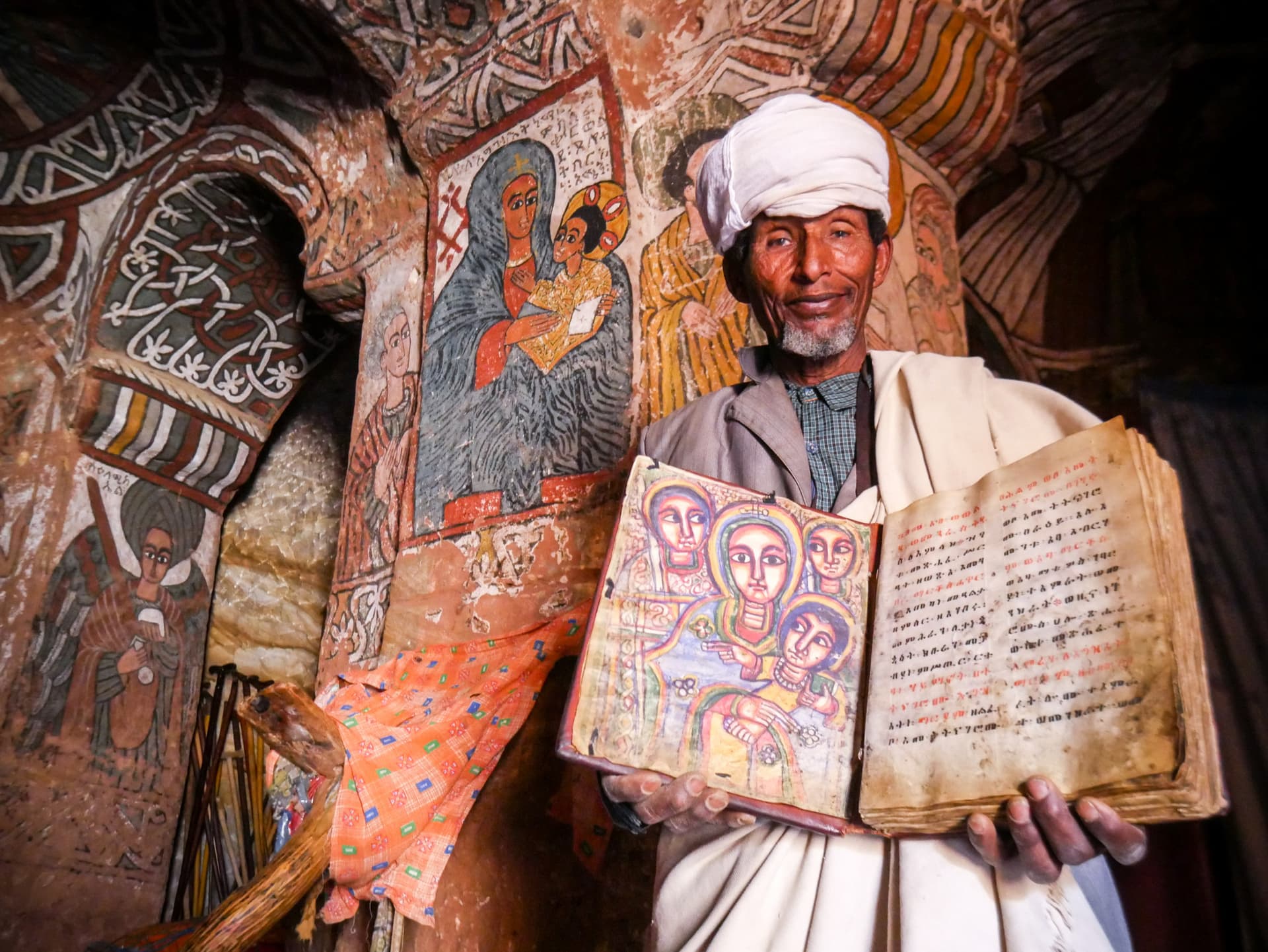
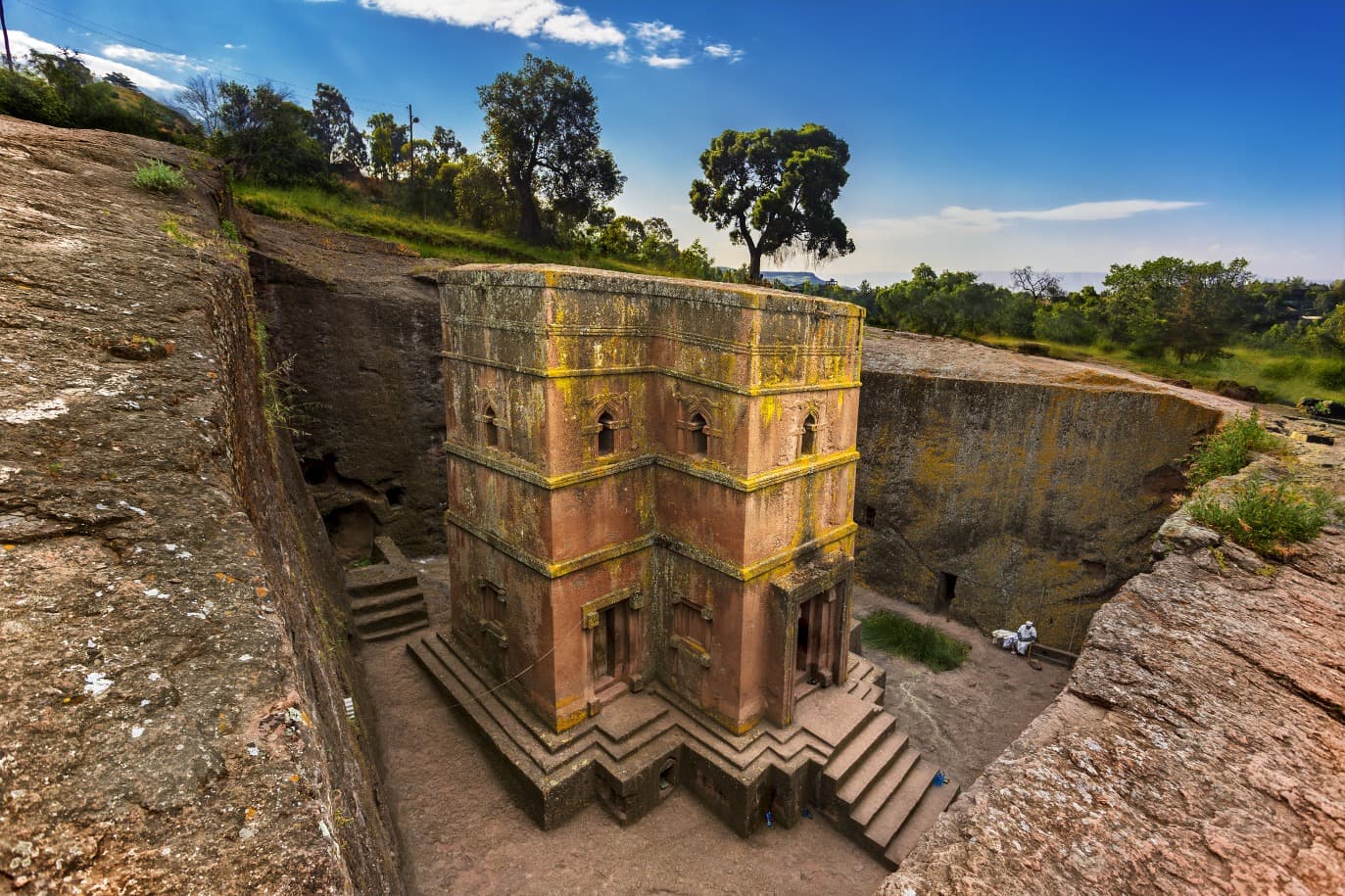
Beyond Gondar, the road climbs toward the Simien massif, which we treat as a separate region, then descends toward Axum and Tigray. Lalibela, at 2,500 meters, is most efficiently reached by a one-hour domestic flight from Addis Ababa or Gondar. Its eleven monolithic churches, carved from red tuff in the twelfth century under King Gebre Mesqel Lalibela, remain active places of worship: priests in white turbans, readings of manuscripts in Geez, frankincense. Beta Giyorgis, the church in the shape of a Greek cross carved into the ground 12 meters deep, is the most photographed site on the complex.
Daily life in these highlands remains profoundly agrarian. Amhara and Tigrayan peasants cultivate barley, sorghum, and teff, and raise cattle, sheep, and horses. Weekly markets in villages like Hawzen or Awra Amba structure the local economy. Cuisine revolves around injera served with preparations spiced with berbere: doro wat (braised chicken), shiro (chickpea puree), kitfo (seasoned raw beef) in the Gurage region. Coffee, originating from the south of the country, is prepared here in a long ceremony with grains roasted in front of the guest, three successive servings, frankincense.
For our English-speaking team based in Addis Ababa, the Historic North remains the most legible entry point for a first trip to Éthiopie: a clear narrative thread (Aksum, Gondar, Lalibela), reasonable distances thanks to Ethiopian Airlines domestic flights, and a density of UNESCO-listed sites over 800 kilometers.
To discover
Monolithic churches of Lalibela. Eleven sanctuaries carved from red tuff in the twelfth century, still used for daily services. Visits recommended at dawn when priests recite psalms in Geez, before the tour groups arrive.
Monasteries of Lake Tana. Boat crossing to the Zege peninsula to see the frescoes of Ura Kidane Mehret. The return skirts water lilies and white pelicans fishing near the shores.
Fasil Ghebbi in Gondar. Royal enclosure of six castles built between 1636 and 1800. The ceiling of angels at Debre Berhan Selassie, 2 km from the center, can be visited as an extension in half a day.
Timkat festival in January. Three days of processions celebrating Orthodox Epiphany, particularly intense in Gondar and Lalibela on January 18, 19, and 20. Lodging should be reserved six months in advance.
Blue Nile falls at Tis Issat. One-hour walk from the village to reach the viewpoint facing the falls. Maximum flow between August and October, after the rainy season.
When to go
The favorable window extends from October to March. Rains from the main season (kremt) fall from June to September, sometimes up to 200 mm per month in Bahir Dar, making some secondary tracks difficult and views often obscured by altitude clouds. October and November offer the greenest landscapes, just after the rains, with teff fields in yellow bloom around Gondar. From December to February, skies are clear and dry, but nights are cold: 5 to 10°C in Lalibela, sometimes near 0°C on the heights of the nearby Simien. Days remain pleasant, around 22 to 25°C in full sun.
March and April mark an acceptable transition, with the first showers of the small season (belg) usually brief. May is more unpredictable. For those wishing to attend major religious festivals, note Genna (Orthodox Christmas) on January 7 in Lalibela, Timkat on January 18 to 20, and Meskel on September 27. These dates concentrate crowds at a few sites, to be anticipated with our agency several months in advance.
Practical advice
Allow seven to ten days to cover the classic itinerary of Bahir Dar, Gondar, and Lalibela, alternating domestic flights (45 minutes to 1 hour between cities) and asphalt roads. Five days allow you to see the essentials in Gondar and Lalibela only. The logistical entry point is Addis Ababa, where daily Ethiopian Airlines flights depart to the four airports in the north. Hotel comfort levels are adequate in regional capitals (3 to 4-star lodges in Bahir Dar and Lalibela), more rustic in village stops.
The Historic North combines naturally with the Simien massif (3 to 4 additional days of trekking from Gondar) and with the Danakil depression for experienced travelers seeking strong geographic contrast. An extension toward Harar and the East, or toward the Omo Valley, requires returning through Addis Ababa and 4 to 6 additional days. This region is particularly suited to travelers interested in history, religious art, and anthropology; families with young children will find their place if the pace remains moderate and altitudes are approached progressively.