The Dassenech
The Dassenech
A pastoral people of the Omo Delta, the Dassenech live in Omorate, southwestern Éthiopie. Practical guide: history, clans, rituals and village access.
The Dassenech (also spelled Daasanech, Daasanach or Dasenech) form a pastoral community in southwestern Éthiopie, settled in Omorate district, around the Omo River delta. Their territory extends further north into Kenya, near Lake Turkana. The term "Dassenech" means "people of the delta" in their language. Once referred to by the names Marille, Geleba, Galeb or Geleb, these designations have been abandoned due to their negative connotations.
Why visit the Dassenech villages
Meeting the Dassenech offers insight into a clan-based social organization, a pastoral economy adapted to an arid environment, and collective rituals still practiced today. Unlike certain neighboring tribes more exposed to tourism, the Dassenech live in seclusion, on the opposite bank of the Omo, which adds a dimension of geographic isolation to your visit.
The journey does raise ethical questions, however (photography, remuneration, commodification of customs) that should be addressed with a serious local guide and respectful behavior.
History and origins
According to oral tradition, the Dassenech left their ancestral homeland of Koro, in northern Kenya, following a prolonged drought. In search of water and pasture, they moved north and found an area suitable for herding along the Lower Omo. This territory was then occupied by the Borena, an Oromo tribe, which led to conflict. Confrontations, initially limited to cattle raids, intensified before the Dassenech finally settled on the riverbanks.
Dassenech society is today organized into eight clans: Ri'ele, Randal, Oro, Naritch, Koro, Inkoria, Inkabelo, and an eighth group according to local sources. Each clan has its own territory and community functions (fishing, hunting, defense). The Inkabelo are recognized as the wealthiest. The whole is governed by a council of elders, the "Aras," a term meaning "authority."
What you will see on-site
Housing and daily life
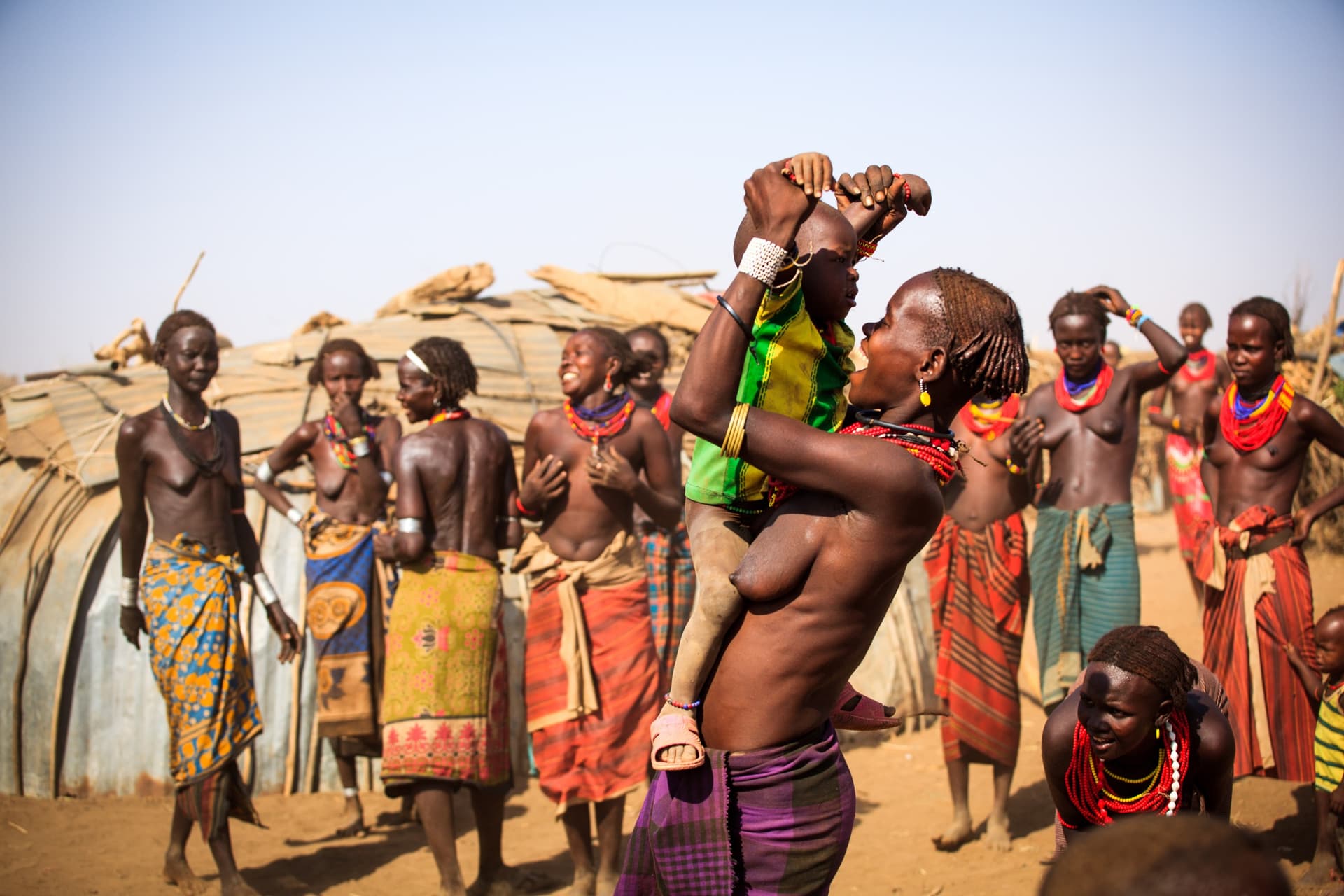
The Dassenech live in semi-circular huts built with branches, sticks, reeds and animal hides. These lightweight dwellings, dismantled and rebuilt by women as they move, feature a central hearth and a floor covered with mats. The herding of cattle, goats and sheep provides meat, milk and hides. Crocodile meat and eggs are part of the diet, while donkey meat is reserved for distinguished guests at weddings. A sub-group, the "Dies," practices subsistence farming (beans, squash, corn, sorghum).
Appearance and adornments
Dassenech women wear perforations below the lower lip, often decorated with feathers. Their hairstyles incorporate salvaged elements (metal capsules, zippers) mixed with beads and shells. Some wear long dresses made of cowhide, others wear colorful fabrics tied at the waist. Hairstyle indicates marital status: hair pulled forward for single women, pulled back for married women.
Men wear loincloths or pieces of fabric tied at the waist, sometimes completed with braided hairstyles or partially shaved heads according to their status. Red ochre serves as a pigment for body and hair painting during ceremonies. They typically carry sticks and spears for cattle herding. Contact with market areas gradually introduces modern clothing (t-shirts, shorts).
Rites of passage
The Dimi (or Dimmi) marks the puberty of girls, generally between 8 and 10 years old. It lasts approximately six weeks and brings together the men of the family group. The father sacrifices 10 to 30 cattle, symbolizing the future bride price. Men called "Bulls" bless the young girl for her fertility. At the end of the ritual, the girl receives ostrich feathers and a leopard skin. The participating fathers in turn achieve the status of "Bulls."
Male circumcision takes place between 10 and 14 years old, collectively within the clan, over several months. Female excision occurs between 10 and 12 years old (clitoral ablation); this practice, which traditionally conditions access to marriage, is now widely contested by health authorities and local associations.
Marriage is forbidden within the same clan. The future husband pays a bride price that can reach around fifty head of cattle depending on family means. Polygamy is permitted, with cases going up to a dozen wives, although this remains exceptional in practice. Four types of unions coexist: arranged, consensual, by abduction, or by inheritance upon the death of a relative.
When to visit
The lower Omo Valley is more accessible during the dry season, approximately from June to February, when passable tracks allow reaching Omorate without major difficulty. The rainy periods (March-May) complicate travel and make ford crossings problematic. Check locally regarding the ceremony calendar, which is not guaranteed for visitors.
Practical information
A permit issued by the immigration office in Omorate is mandatory before any visit to Dassenech villages. Local authorities in Arba Minch or Jinka can also guide you through the procedures. The villages are located on the opposite bank of the Omo River: access is by canoe or local boat from Omorate.
Regarding photography, plan for a per-photo fee, negotiated in advance with your guide to avoid tension. Bring water, sun protection and respectful behavior; avoid clothing that is too short and systematically ask permission before photographing children or rituals.
How to get there
Omorate is generally reached by road, after a stop in Jinka, Turmi or Arba Minch. From Addis Ababa, allow several days of travel by 4x4, or a domestic flight to Arba Minch or Jinka, followed by several hours on rough tracks. Most travelers go through a local agency based in Omorate, Turmi or Jinka, which organizes transport, permits and guidance.
Things to see nearby
The lower Omo Valley concentrates several neighboring communities, each with its own customs: the Hamer (bull-jumping ceremony), the Karo (body painting), the Mursi (lip plates). Further north, the Dorze villages on the Guge massif offer another face of rural Éthiopie, with their elephant head-shaped bamboo houses. Travelers extending their itinerary can then head to the volcanic landscapes of the Danakil or the historic sites of the north such as the Abreha Atsbeha church.
Frequently asked questions
Frequently asked questions
Yes. A permit issued by the immigration office in Omorate is mandatory. Local agencies typically handle this as part of their services.
Yes, but a per-photo fee is expected. The rate is negotiated beforehand with your guide. Always ask permission, particularly for children and ritual scenes.
The dry season, approximately from June to February, offers the most reliable travel conditions. Rains from March to May complicate access to tracks and fords.
The Hamer, Karo and Mursi are the communities most frequently included in an ethnographic circuit in the lower Omo Valley, around Turmi and Jinka.
The question is legitimately debated. Choosing a committed agency, limiting intrusive photos and listening to local guides contribute to a more respectful visit.
Preparing your journey
A visit to the Dassenech naturally fits into a broader circuit of the Omo Valley and southern Éthiopie. To build a custom itinerary including ethnographic encounters, volcanic landscapes and historic heritage, consult our suggestions for trips to Éthiopie.
Interested in this visit?
We can include it in your personalised itinerary.