Danakil Depression and Dallol
Danakil Depression and Dallol
A unique geothermal site in northeastern Éthiopie, Dallol combines multicolored acid pools, salt chimneys and fumaroles in the Danakil Depression.
Dallol is a geothermal site located in the Danakil Depression, in northeastern Éthiopie, approximately 15 km from the Eritrean border. Positioned nearly 100 meters below sea level in the Rift Valley, it combines multicolored acid springs, salt chimneys and fumaroles, situated on one of the hottest habitable points on the planet.
Why visit Dallol
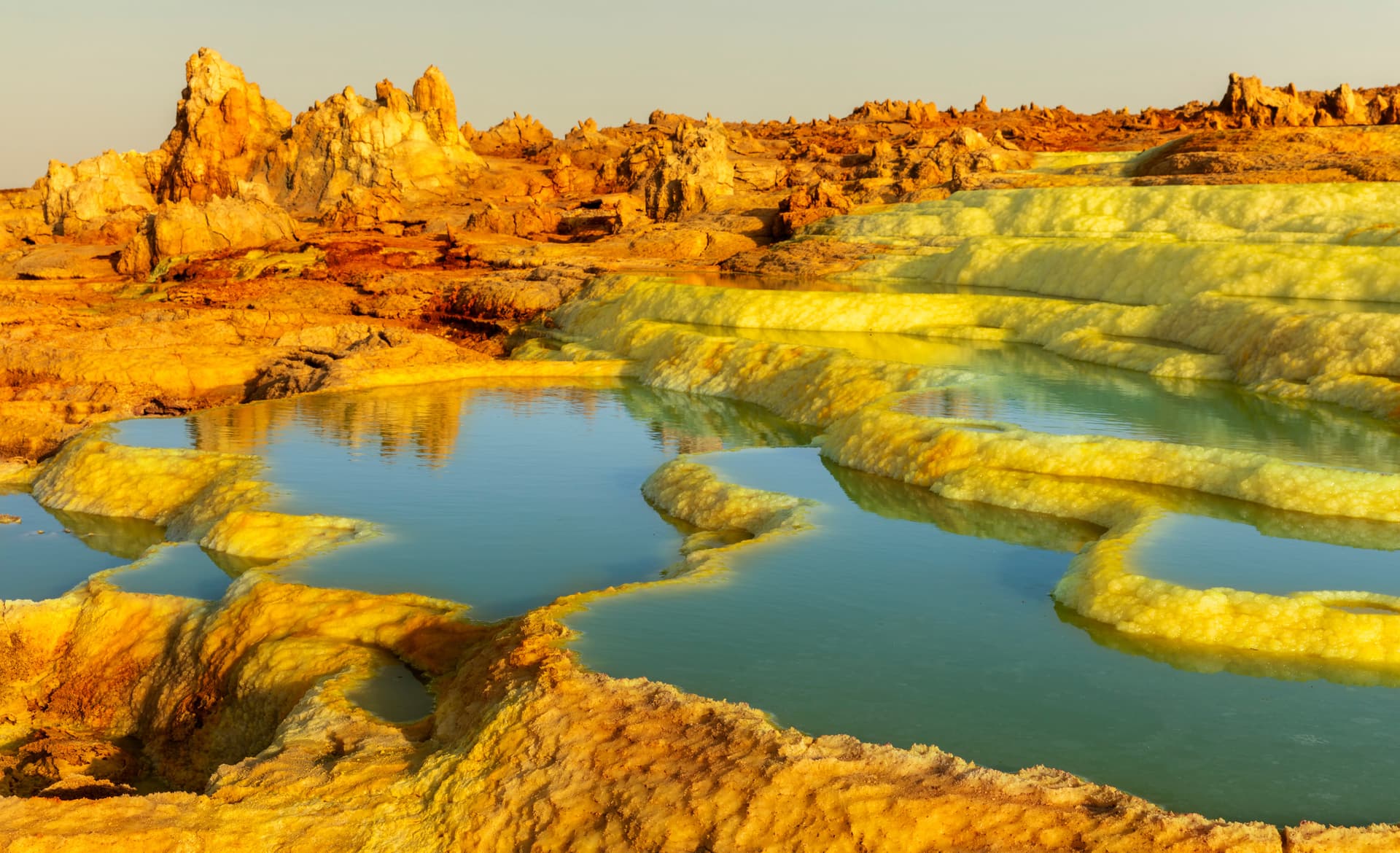
Few terrestrial landscapes resemble Dallol. Sulfurous yellows, copper greens and ferrous oranges of the acid pools create a mineral backdrop that evokes an alien planet more than an African site. The geological context is exceptional: a magmatic pocket 2,000 meters deep heats a thick layer of salt and potash, generating at the surface phenomena rarely found together: geysers, acid lakes, fumaroles and crystalline deposits.
The experience is also sensory: the ground cracks beneath your feet, the air smells of sulfur, and the heat sets a slow pace. It is an austere site, one that must be earned, and one that leaves a lasting impression on travelers.
History and exploration of the site
The Danakil Depression has long been inhabited by the Afar people, who exploit salt in plates transported by camel through the desert. Industrial extraction led, in the first half of the 20th century, to Italian potash mining, whose remains form today a ghost village abandoned since 1943.
Long kept at arm's length by its extreme climate and geological instability, Dallol saw no tourism before the early 2000s. It was opened to visitors starting in 2001, then more widely from 2005. The site regularly appears in UNESCO thematic lists devoted to volcanic landscapes, though it has not been officially inscribed in the World Heritage list to date.
What to see on site
Acid pools and colored deposits
The heart of the site is a hydrothermal plateau where gases, passing through layers of salt and potash, have deposited on the surface yellow and orange concretions, some several meters high. The crystallization of salt takes varied forms here: filaments, cubes, snowflakes, terraces, leaves, water lilies. Each pool has its own tint, determined by iron, sulfur or extremophile algae.
The salt fairy chimneys
Southwest of Dallol stand stratified salt pillars, capped with gypsum, reaching about thirty meters in height. Detached from the walls, these fairy chimneys overlook salt banks between purple silt layers. This is one of the most photogenic landscapes in the area.
The Italian ghost village
Nearby, the ruins of the former potash extraction plant, exploited by the Italians until 1943, bear witness to attempts at industrial occupation of the Danakil. Collapsed walls, rusted rails and machinery create a backdrop in contrast to the colors of the geothermal site.
Hot springs, geysers and acid lakes
The site also contains hot springs, geysers and acid lakes with milky or bright green tints. These areas are fragile: it is imperative to strictly follow the routes marked by guides, as some salt crusts may give way under a person's weight.
Practical information
- Visit duration: allow a half-day at Dallol itself, integrated into a 3-4 day circuit in the Danakil.
- Organization: visits must be organized with a local operator, accompanied by an armed escort required by Ethiopian authorities for security reasons in this border area.
- Equipment: sturdy closed shoes (sharp salt), hat, sunglasses, scarf for sulfur vapors, several liters of water per person.
- Cost: Danakil circuits are among the most expensive in Éthiopie due to logistics (4x4, escort, water, camp). Budget accordingly.
- Accommodation: nights in tents or under the stars on wooden beds in basic Afar villages.
When to go
The annual average temperature at Dallol hovers around 41°C, with highs reaching 46°C and peaks potentially exceeding 50°C in the shade. It is one of the hottest inhabited regions on the planet. The most bearable period extends from November to February, when temperatures drop slightly and rainfall is rare. Avoid June to September, the most trying period. Departures typically begin very early in the morning to reach the site before midday heat.
How to get there
The classic starting point is the city of Mekele, capital of Tigray, accessible by domestic flight from Addis Ababa. From Mekele, allow one day of travel by 4x4 to reach the Danakil Depression, via sometimes difficult tracks. Agencies generally group travelers in convoy, with vehicle, cook, local Afar guide and escort. There is no independent tour of the site.
Nearby attractions
Dallol fits into a broader circuit across the Danakil Depression:
- Erta Ale: active volcano home to one of the world's rare permanent lava lakes, accessible via a nighttime trek.
- Lake Assal (Karoum): large salt expanse exploited by Afar caravans.
- Mekele: urban stop and logistical gateway for Danakil expeditions.
- More broadly, the rock-hewn churches of Tigray are accessible from Mekele, such as the Abreha Atsbeha Church.
Frequently asked questions
Frequently asked questions
The site poses real risks: fragile salt crusts over acid pools, toxic gases, extreme heat. Guided by an experienced local guide and with appropriate equipment, the visit remains feasible. The border zone also requires an armed escort.
Yes. The visit can only be done through an approved operator, with an Afar guide and escort. Independent access is not permitted.
A complete circuit (Dallol + Erta Ale + salt lake) requires 3-4 days from Mekele. A shorter version focused solely on Dallol is possible in 2 days.
From November to February, when temperatures are least extreme. Avoid summer, when heat becomes difficult to endure.
No. The site is regularly cited in inventories of remarkable volcanic landscapes, but it is not officially inscribed on the World Heritage list to date.
Plan your trip
Dallol naturally fits into an itinerary combining the historic north (Lalibela, Aksum, Gondar) and the geological adventure of the Danakil. To build a tailor-made circuit integrating this site with other regions of the country, consult our travels in Éthiopie.
Interested in this visit?
We can include it in your personalised itinerary.