Church of Beta Maryam
Church of Beta Maryam
12th-century rock-hewn church in Lalibela, Bete Maryam houses a veiled pillar inscribed in Ge'ez, Arabic and Hebrew, at the heart of Éthiopie's UNESCO heritage.
Bete Maryam, "House of Mary," is part of the group of rock-hewn churches of Lalibela, in the Amhara region, in northern Éthiopie. Carved from a single block of volcanic rock in the 12th century, it is one of eleven monolithic sanctuaries designated as a UNESCO World Heritage site in 1978. Renowned as the preferred church of King Lalibela, it preserves a permanently veiled pillar around which one of the most singular traditions of Éthiopian Christianity has developed.
Why visit Bete Maryam
Within the Lalibela complex, Bete Maryam stands out for three rare features:
- A bas-relief of two horsemen vanquishing a dragon above the main door, an unusual motif in Eastern Christian art where animated representations are rare.
- A central pillar covered with white fabric, never lifted, bearing inscriptions in Ge'ez, Arabic and Hebrew.
- A Marian dedication that makes it one of the country's principal sites of Marian pilgrimage, particularly vibrant during major Orthodox feast days.
The church is visited as part of the northern group circuit of the complex and can be combined with Bete Medhane Alem, Bete Golgotha, or, via an underground passage, with other nearby sanctuaries.
History
Éthiopie was Christianized in the 4th century under Emperor Ezana, making it one of the world's earliest centers of Christianity. Eight centuries later, King Lalibela of the Zagwe dynasty commissioned the construction of a series of churches carved into rock designed to recreate a new Jerusalem on Éthiopian soil, at a time when access to the Holy Land had become difficult for pilgrims. According to tradition, the entire construction project lasted nearly 24 years.
Bete Maryam is generally presented as one of the earliest churches in the group—the exact order of construction remains debated—and was likely built in the second half of the 12th century. It takes its name from the Virgin Mary, a central figure in Éthiopian spirituality. Local tradition reports that Christ appeared to King Lalibela in this church to transmit a divine vision, which was subsequently inscribed on the central pillar. It is this legend that justifies the permanent veil covering the column to this day.
What to see on site
Exterior architecture
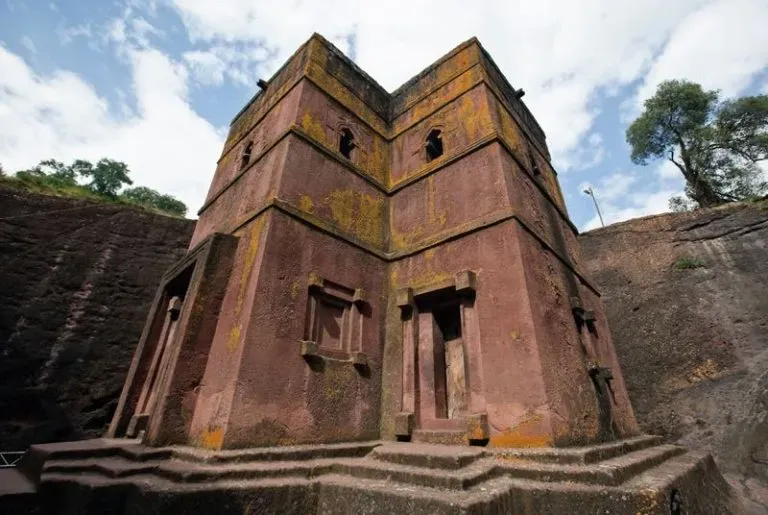
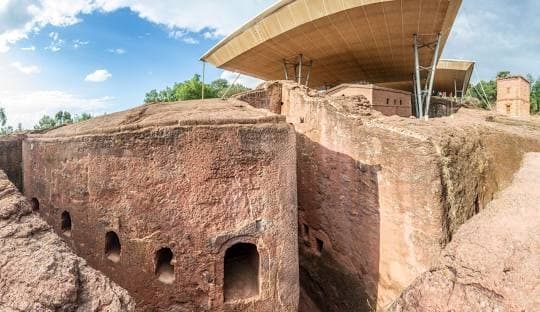
Bete Maryam measures approximately 12 meters long, 10 meters wide and 10 meters high. Of cruciform plan, it features a flat roof and was entirely carved from volcanic rock by sculpting both the exterior and interior of the block. The bas-relief of the two horsemen and dragon, situated above the main door, deserves careful observation: its rarity makes it one of the most discussed iconographic elements on the site.
The interior
The space is organized around a large central hall, lateral wings and an apse housing the altar. Twelve pillars support the ceiling. Light enters through small openings cut into the rock, maintaining marked darkness. The walls and ceilings retain geometric patterns, floral elements and frescoes belonging to medieval Éthiopian religious art.
The veiled pillar
The central pillar, known as the ladder of Jacob, is engraved on all four faces with inscriptions in Ge'ez, Arabic and Hebrew. Covered permanently with white fabric, it is the subject of a tradition according to which lifting the veil would cause the "disappearance of the world." Priests teach that it bears words transmitted by Christ to King Lalibela.
The upper floor and treasures
Beneath the pitched roof, seven rooms preserve the church's most ancient treasures: processional crosses, manuscripts, liturgical ornaments. Access is strictly reserved to priests, who bring out certain objects during major feast days.
Religious significance
The Éthiopian Orthodox Tewahedo Church follows the Alexandrian rite and venerates Mary as Theotokos, "Mother of God." Bete Maryam, through its name and dedication, is one of the country's most frequented Marian sanctuaries. Ceremonies are celebrated there throughout the year, and the church remains an active place of prayer as much as a visited site.
Practical information
- Admission: a single ticket grants access to the entire Lalibela rock-hewn complex, valid for several days. It is purchased at the main entrance, near the northern group where Bete Maryam is located.
- Guide: using an accredited local English-speaking guide is highly recommended to understand the iconography and traditions associated with each church.
- Dress code: shoulders and knees covered. Shoes must be removed before entering the church, as in all Éthiopian sanctuaries.
- Photography: permitted outside, sometimes subject to a surcharge inside; flash should be avoided on frescoes.
- Duration of visit: allow 30 to 45 minutes for Bete Maryam alone, and half a day for the northern group of the complex.
When to visit
Lalibela can be visited year-round, but the dry season from October to March offers the most comfortable conditions for walking the site. Two periods are particularly memorable:
- Genna, Éthiopian Orthodox Christmas, celebrated on January 7, features a major vigil in Lalibela that draws tens of thousands of pilgrims.
- Fasika, Orthodox Easter, in late April or early May according to the Julian calendar, is the other major liturgical season.
During these holidays, crowds are large and accommodations must be booked months in advance.
How to get there
Lalibela is isolated in the highlands of the north. The simplest route is by plane: domestic flights connect Addis Ababa to Lalibela airport, often via Gondar or Axum as part of the Historical Circuit of the North. Allow approximately 1 hour of flight time from Addis Ababa, then 30 minutes by road between the airport and the city center.
Access to the rock-hewn churches is on foot from the town. The main entrance to the complex is near the northern group, where Bete Maryam is located. Inside, passages, staircases and tunnels carved into the rock connect the buildings to one another. Bete Maryam is notably accessible via Bete Medhane Alem, by crossing a channel, and an underground passage connects it to other sanctuaries.
Nearby
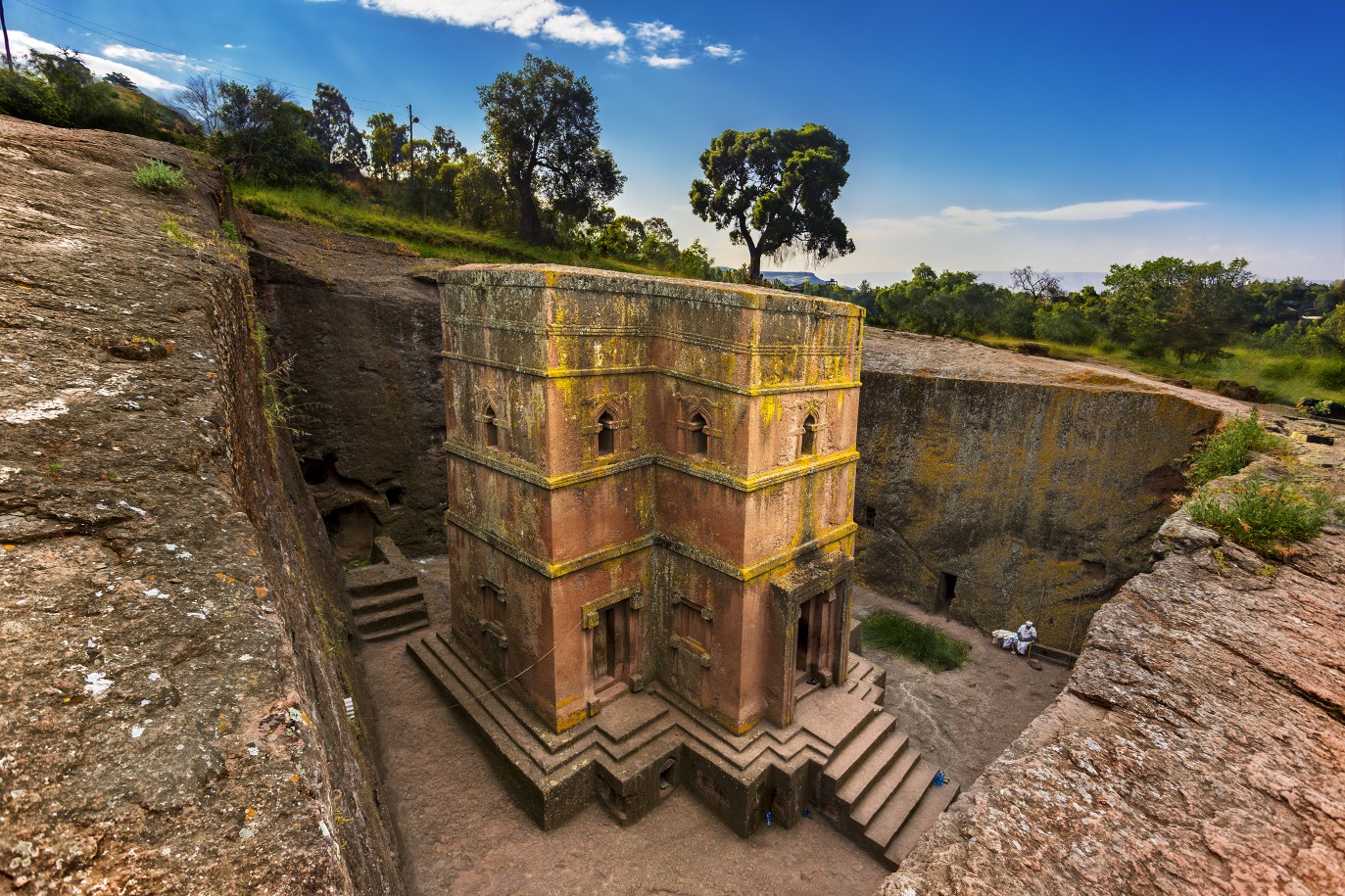
The Lalibela complex comprises eleven monolithic churches divided into two groups (north and south-east) plus Bete Giorghis, which stands apart. Bete Maryam is next to Bete Medhane Alem, the world's largest monolithic church, and is within short distance of Bete Amanuel and Bete Giorghis, Éthiopie's most photographed cross-shaped church.
On the Historical Circuit of the North, the stay is generally extended to include other major sites:
- The church of Abreha Atsbeha, another Éthiopian rock-hewn sanctuary.
- The church of Debre Birhan Selassie in Gondar, famous for its ceilings painted with angels.
- The Castle of Fasilidas, heart of the former imperial capital of Gondar.
Frequently asked questions
Frequently asked questions
In the northern group of the Lalibela rock-hewn complex, in the Amhara region (Lasta zone), in northern Éthiopie. The main entrance to the complex is very close to it.
No. A single ticket, purchased at the main entrance, grants access to all eleven churches of Lalibela and remains valid for several days.
The pillar is visible from within the church, but it remains covered with white fabric permanently. Tradition forbids lifting the veil, and no visit permits an exception.
October to March for dry weather. To experience the church in its liturgical dimension, aim for Genna (Orthodox Christmas, January 7) or Fasika (Orthodox Easter), booking well in advance.
Learn more
Bete Maryam is part of a broader itinerary through the highlands and historical sites of the north. To plan a journey combining Lalibela, Gondar, Axum and the Simien landscapes, consult our circuits in Éthiopie.
Interested in this visit?
We can include it in your personalised itinerary.