Bale National Park
Bale National Park
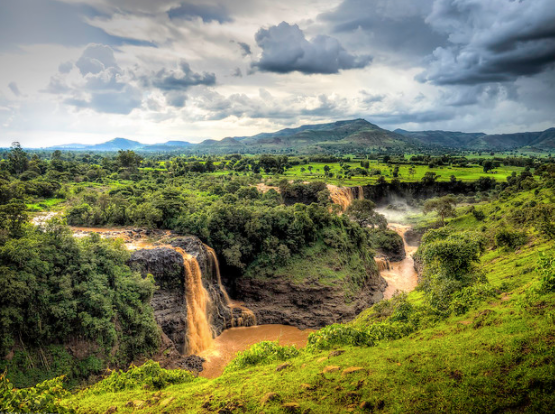
Inscribed as a UNESCO World Heritage Site in 2023, Bale National Park is home to the Ethiopian wolf, the Sanetti Plateau at 4000m, and the vast Harenna Forest.
In southeastern Éthiopie, within the Oromia region, the Bale area spans some 50,000 km² of high plateaus, humid forests, and volcanic valleys. Its national park, inscribed as a UNESCO World Heritage Site in September 2023, is home to exceptional endemic wildlife, including the Ethiopian wolf and the mountain nyala. Approximately 400 km from Addis Ababa, Bale ranks among East Africa's most singular biodiversity zones.
Why visit Bale National Park
The park brings together in a single space several vegetation zones rarely found in combination: afro-alpine grasslands, juniper forests, tree heather moorland, and humid tropical forest. This mosaic explains the density of endemic species, particularly on the Sanetti Plateau and within Harenna Forest.
Bird enthusiasts record more than 280 bird species, including at least 16 endemic species. Hikers find little-trafficked high-altitude trails, and travelers interested in Oromo culture encounter a pastoral way of life still very much present around Dinsho, Goba, and Rira.
Geography and the formation of the Bale Mountains
The Bale Mountains are ancient volcanoes whose activity shaped the region's high plateaus and deep valleys. Two summits dominate the landscape: Mount Batu (4,307 m) and Tullu Dimtu (4,377 m), Ethiopia's second-highest mountain after Ras Dashen in the Simien.
The national park, founded in 1970, extends across approximately 2,200 to 2,500 km². Its headquarters are located in Dinsho. It is divided into five main zones:
- Gaysay grasslands,
- juniper forests, from Dodola to Dinsho,
- afro-alpine grasslands,
- the Sanetti Plateau, around 4,000 m in altitude,
- the Web Valley.
What to see and do in Bale
The Sanetti Plateau and the Ethiopian wolf
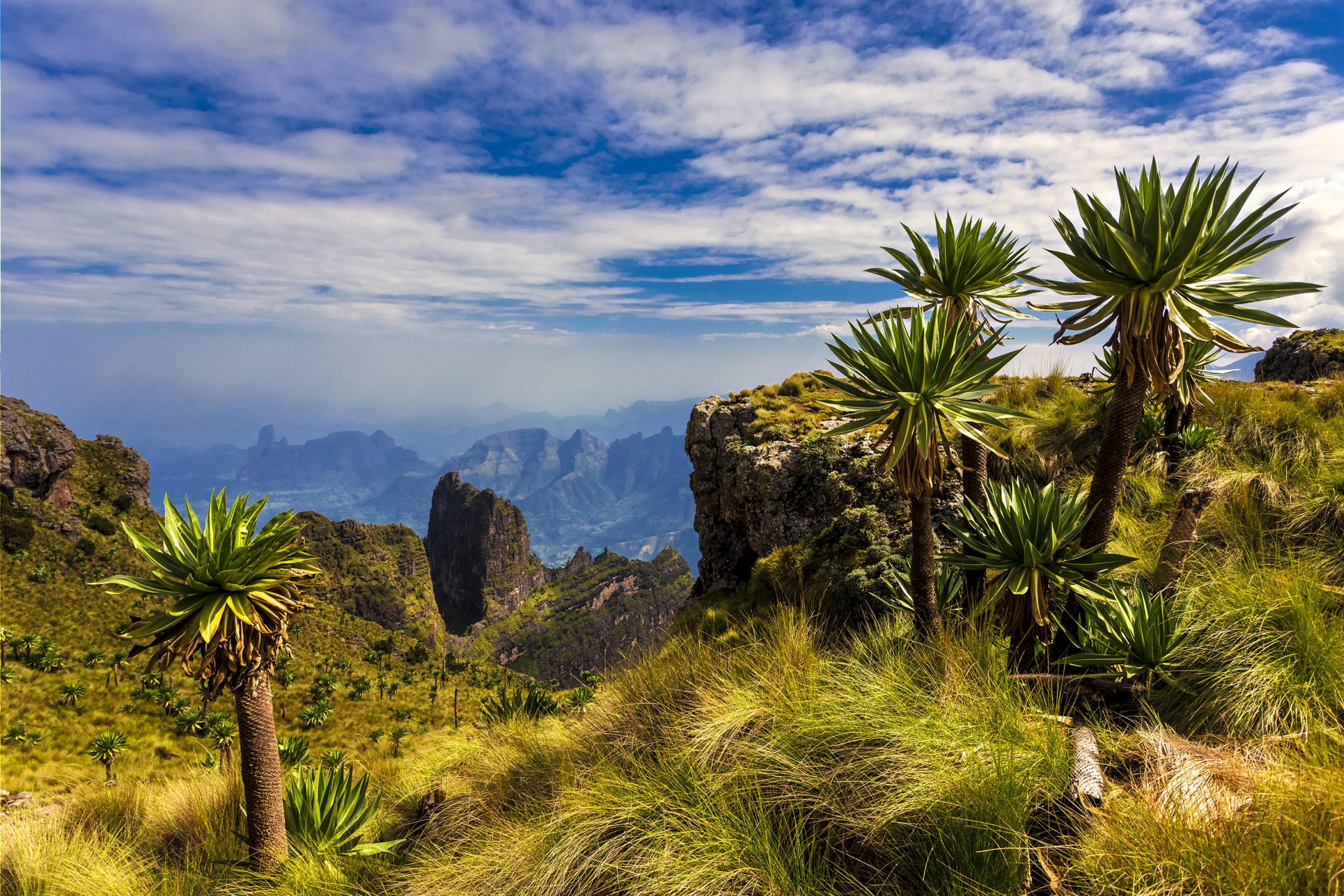
The Sanetti Plateau, a vast afro-alpine expanse situated around 4,000 m, is the best place to observe the Ethiopian wolf, the world's rarest endemic canid. It is also a privileged observation ground for raptors: lappet-faced vulture, lanner falcon, augur buzzard, lammergeier, and golden eagle.
High-altitude flora
Between 3,100 and 4,377 m, giant lobelia and Alchemilla structure the landscape. Floral diversity decreases with altitude, but one also encounters geranium, red hot poker, saffron, and peppermint—the latter two species being used locally for their medicinal properties.
Terrestrial fauna
Beyond the Ethiopian wolf, the park is home to emblematic species such as the mountain nyala, the bushbuck, and the Bale monkey. Wooded zones shelter the black-and-white colobus, green monkey, and olive baboon. You may also encounter the klipspringer, golden jackal, warthog, Menelik's bush pig, and the red duiker. Rarer and more elusive, lions with black manes, leopard, spotted hyena, African wild dog, and serval still frequent certain sectors.
Birds
With more than 280 species, including at least 16 endemic, Bale ranks among Africa's top birdwatching destinations. Among striking species: crowned crane, Abyssinian hornbill, yellow-fronted parrot, and spotted-breasted plover. Forests and grasslands also host Erckel's francolin and various species of coursers.
Harenna Forest
South of the Sanetti Plateau, Harenna Forest spans nearly 4,000 km², of which approximately 700 km² are dominated by Hagenia abyssinica. It is Éthiopie's second-largest forest. The villages of Rira and Delo-Mena, situated at the forest edge, provide excellent observation points at dawn, particularly for primates and, with considerable luck, large predators.
The Sof Omar Caves
East of the park, the Sof Omar Caves form a limestone network of approximately 15 km traversed by the Web River. The "Hall of Columns," with its immense limestone pillars, is the most impressive passage. Exploration requires roughly 3.5 hours of walking and a guide is necessary. Crocodiles inhabit the Web River but do not enter the caves.
Fishing and complementary activities
Fishing is legal in the Web and Shaya rivers, which host rainbow trout and brown trout. The region also lends itself to hiking on foot or horseback, and part of the park can be explored by vehicle.
Practical information
- Park entry: entrance fee payable on site; an English-speaking official guide is mandatory.
- Park headquarters: Dinsho, the logical starting point for most circuits.
- Accommodation: lodges and guesthouses in Dinsho, Goba, and Robe; rustic camps at altitude.
- Equipment: warm clothing is essential on the Sanetti Plateau, where temperatures frequently drop below freezing at night.
- Health: altitude is felt from 3,500 m onward; plan time for acclimatization.
When to visit Bale
The rainy season extends from June to September: daily precipitation makes access to high-altitude zones difficult and tracks may become impassable. The best period spans October to April, with clear days and cold but starlit nights, ideal for wildlife observation and hiking. The months of November to February generally offer the most stable conditions.
How to reach Bale
The park is located approximately 400 km southeast of Addis Ababa. The road, paved for most of the journey, leads to Shashemene and then to Dinsho and Goba; allow a full day of driving from the capital. Public buses also connect Addis Ababa to Robe and Goba, but most travelers prefer a private vehicle with driver, which is more convenient for reaching the various park zones and Harenna Forest.
Culture and population
The region's main towns are Dinsho, Goba, Robe, Delo-Mena, Dodola, and Rira. The population is predominantly Oromo, with Somali and Sidama communities. The dominant language is Afan Oromo. Islam is practiced by approximately 77% of inhabitants, followed by Orthodox Christianity (20%), Protestantism (1%), and animist worship (2%). Pastoralism and subsistence agriculture remain the cornerstones of the local economy.
Conservation challenges
Demographic pressure threatens the park's habitats. Two threats stand out particularly for the Ethiopian wolf: the proliferation of domestic dogs, vectors of rabies and distemper, and livestock grazing in afro-alpine zones, which reduces the availability of rodents on which the wolf feeds.
Nearby attractions
To extend an Éthiopie itinerary, several sites complement a Bale visit well:
- The Ethiopian wolf, the flagship species to observe on the Sanetti Plateau.
- Menagesha National Forest, near Addis Ababa, for a more accessible introduction to Éthiopie's forests.
- The Omo Valley and the Mursi, to the southwest, for an ethnographic immersion.
- Erta Ale Volcano and Dallol, in the north, a striking geological contrast with Bale's high plateaus.
FAQ
Frequently asked questions
Plan your trip
Bale National Park fits naturally into a circuit through southern Éthiopie, complementing the northern highlands. To build a custom itinerary including Bale, consult our selection of trips to Éthiopie.
Interested in this visit?
We can include it in your personalised itinerary.