The Abyssinian Wolf
The Abyssinian Wolf
Endemic to the Ethiopian highlands, the Abyssinian wolf can be observed in the Bale Mountains and Simien. Complete guide: sites, season and access.
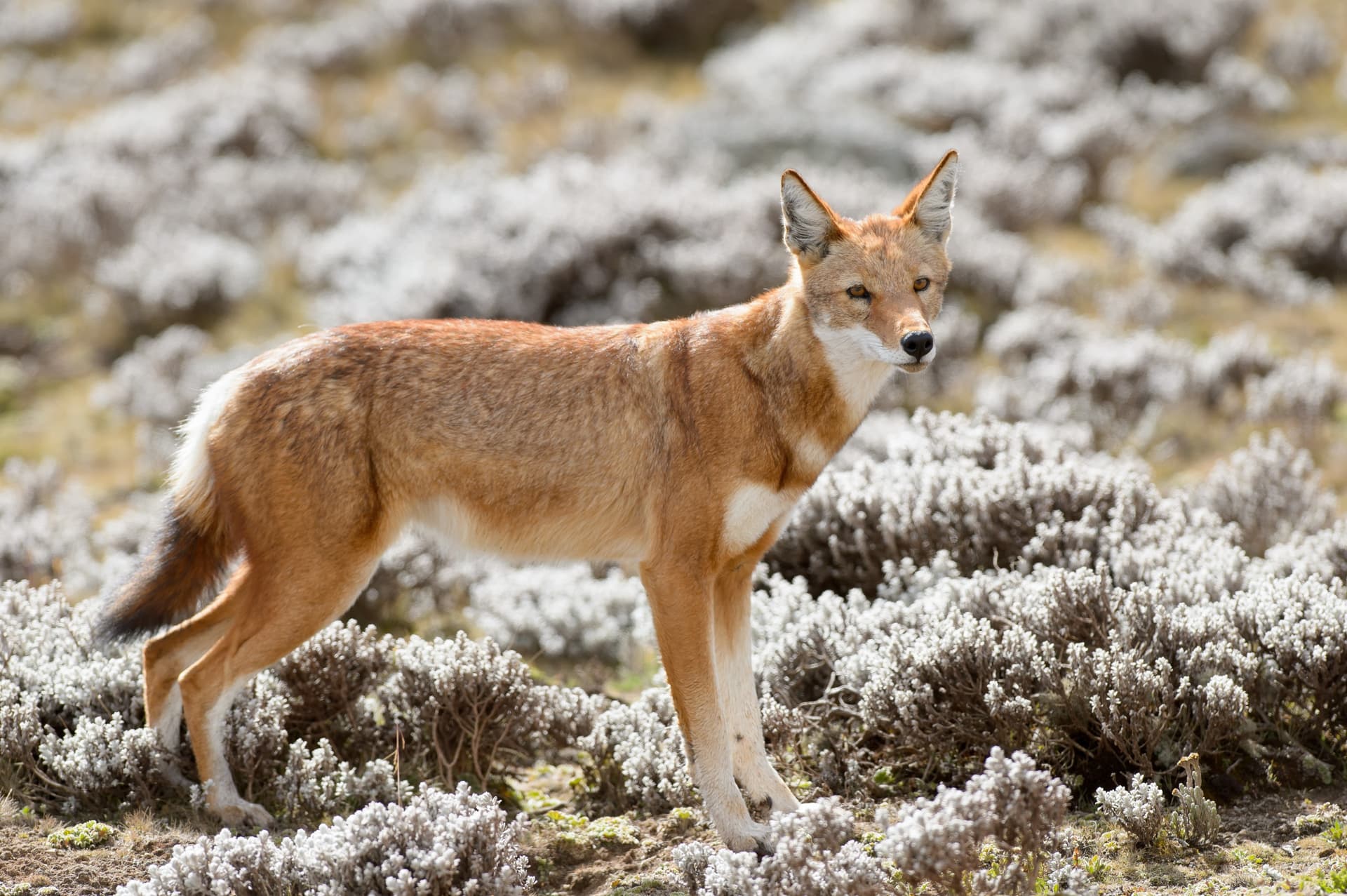
The Abyssinian wolf (Canis simensis) is one of the world's rarest canids, endemic to the Ethiopian highlands. Known locally as caberou, Simien jackal or Simien fox, it lives exclusively between 3,000 and 4,370 metres altitude, in two main massifs: the Bale Mountains National Park and the Simien National Park.
Why observe the Abyssinian wolf
The caberou is the world's second most threatened canid after North America's red wolf. Seeing it in its natural habitat is a rare encounter: the population is estimated at around 500 individuals, scattered across a few isolated massifs in Éthiopie. No other country in the world offers this experience.
Beyond the animal itself, the observation setting holds its own value. The afroalpine highlands where it hunts—open moorlands, fields of giant lobelias, wind-swept plateaux—rank among Africa's most singular landscapes. The encounter often takes place alongside geladas (hamadryas baboons), with whom wolves share a documented hunting cohabitation.
History and place in Ethiopian culture
The animal's name harks back to the kingdom of Abyssinia, the former designation of Éthiopie. The first documented reference dates to the 3rd century, in the writings of Roman chronicler Gaius Julius Solinus, who described a crested canid: "They leap so high as if they had wings, they never turn upon men."
The species was scientifically described in 1835 by German naturalist Eduard Rüppell, who gave it its binomial name Canis simensis. An ancient Ethiopian superstition surrounds the animal: according to tradition, anyone wearing its fur would die if the hair came into contact with a fresh wound, explaining the absence of hunting for fur in ancient accounts.
Recent history is marked by a major health crisis. Between late September 2003 and January 2004, 65 individuals died from rabies in the Bale Mountains park, a disease likely transmitted by domestic dogs of transhumant herders. By 2008, the species' total population had fallen to 500 individuals.
Where and how to observe the wolves
The Sanetti plateau (Bale Mountains National Park)
The Sanetti plateau, at over 4,000 metres altitude, hosts the largest population of caberouses. It is the most reliable site for an encounter: the open terrain, the density of giant mole-rats (their main prey), and the road crossing the plateau facilitate sightings by vehicle.
The heights of Simien National Park
In the Simien, wolves concentrate around Mount Imet Gogo, Geech camp and Chenek camp. Observation here occurs on foot, among giant lobelia fields and with views over the characteristic escarpments of the massif. Chenek is generally considered the best approach point.
Behaviour to know for observation
- Diurnal activity: wolves hunt during the day, ideal for observation.
- Life in groups of 6 to 20 adults led by a dominant male, but often hunting solitarily.
- Hunting zone over a radius of around 6 km around the territory.
- Preferred prey: the giant mole-rat, captured thanks to an elongated snout adapted to burrows.
- Observable cohabitation with geladas, which unearth rodents by scratching the ground.
- Reproduction: one litter per year, after 60 days of gestation.
The Abyssinian wolf has two subspecies: Canis simensis simensis in the north (Simien) and Canis simensis citernii in the south (Bale). Its silhouette—roughly 1.3 to 1.5 m from snout to tail tip, light tan coat, long legs—evokes a large fox.
When to go
The best observation period corresponds to the dry season, October to March. Sanetti tracks are passable, Simien trails are clear, and visibility is optimal. The major rainy season (June to September) makes Bale roads particularly difficult and limits mountain excursions.
Altitude requires acclimatisation: allow a few days at medium altitude before ascending above 4,000 m. Temperatures can drop below freezing at night on Sanetti and at Chenek, even in the dry season.
How to get there
Access to Bale Mountains Park
From Addis Ababa, two options: a domestic flight to Goba or Robe, followed by road to Dinsho (park headquarters) then the Sanetti plateau; or a bus journey from the capital, longer but more economical. Road conditions at altitude vary significantly by season.
Access to Simien Park
The usual entry point is Gondar, accessible by air from Addis Ababa. From Gondar, you reach Debark (park gateway) by road, then proceed towards Sankaber, Geech and Chenek camps depending on your chosen trek duration.
Practical information
- Visit duration: allow 2 to 3 days minimum on site to maximise observation chances, more if you combine with a trek.
- Fitness level: moderate to demanding depending on itineraries, especially in the Simien where observation is on foot above 3,500 m.
- Guidance: local guide and scout mandatory in Simien Park; recommended in Bale.
- Equipment: warm clothing, windproof jacket, binoculars, sun protection and good hiking boots.
- Observation ethics: do not approach animals closer than 50 m, do not feed, keep dogs away to limit health risk.
What to see nearby
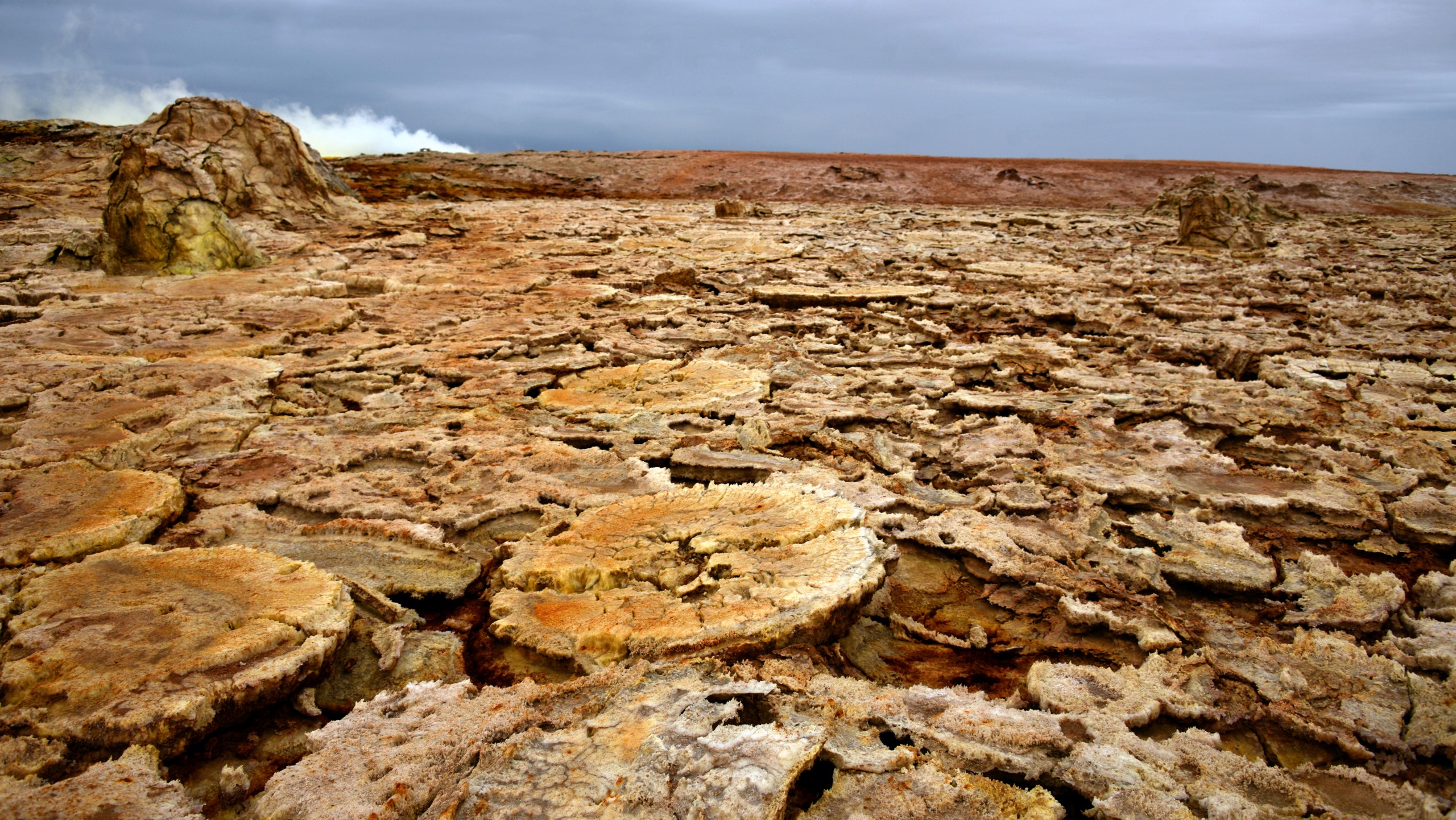
Simien Park naturally combines with a stop at Fasilidas Castle in Gondar, the former imperial capital. Beyond that, Éthiopie offers other discovery grounds: the sources of the Blue Nile and Lake Tana, the volcano Erta Ale and the Danakil depression, or an encounter with the Dorze people to the south. Near Addis Ababa, the Menagesha national forest offers a verdant stop before or after the trek.
Frequently asked questions
Frequently asked questions
Estimates revolve around 500 adult individuals, making it the world's second rarest canid after the red wolf. Figures vary depending on census data and the IUCN classifies the species as "endangered".
For near-certain observation, the Sanetti plateau in Bale Mountains Park remains the best site. Simien Park offers a more complete trekking experience but less systematic encounters.
No. As early as the 3rd century, Solinus noted it did not attack humans. It is a specialist hunter of small rodents, avoiding human presence.
Yes, in both parks. A guide is mandatory in the Simien and strongly recommended in Bale for safety, orientation and observation efficiency reasons.
Between 3,000 and 4,370 metres, in afroalpine moorlands. This altitude specialisation explains its fragility when facing agricultural pressure gnawing at its habitat.
To incorporate Abyssinian wolf observation into a complete itinerary, consult our suggestions for tailor-made travel in Éthiopie.
Interested in this visit?
We can include it in your personalised itinerary.