The Church of Beta Giorghis
The Church of Beta Giorghis
A monolithic church in Greek cross form carved into the volcanic tuff of Lalibela, Beta Giorghis is one of eleven rock-hewn sanctuaries listed as a UNESCO World Heritage site.
The Church of Beta Giorghis (or Bete Giyorgis, "Church of Saint George") ranks among the eleven monolithic sanctuaries of Lalibela, in the Amhara region of Éthiopie. Carved from a single block of volcanic tuff on the Lasta plateau, it stands out for its self-supporting Greek cross form, its isolated position to the west of the site, and its state of preservation. Inscribed as a UNESCO World Heritage site since 1978, it remains an active place of worship for the Éthiopian Orthodox Church.
Why visit Beta Giorghis
- Unique rock-hewn architecture: a building in Greek cross form sculpted inward from the stone, with no added materials.
- A living UNESCO site, animated by priests, pilgrims, and Orthodox festivities.
- A spectacular setting: the church reveals itself to visitors only after descending a narrow canyon carved in a spiral fashion.
- A logical starting point for exploring Lalibela's other monolithic churches.
History
The church was built during the reign of King Gebre Mesqel Lalibela, sovereign of the Zagwe dynasty, between the 12th and 13th centuries. This project arose from a specific context: Saladin's capture of Jerusalem in 1187 closed the pilgrimage route for Éthiopian Christians. King Lalibela then conceived a "New Jerusalem" on the Éthiopian plateau, situated at approximately 2,600 meters altitude, to offer the faithful an alternative sacred site.
Beta Giorghis is dedicated to Saint George, the patron saint of Éthiopie. According to royal chronicles, it was the last church built by King Lalibela. Tradition recounts that Saint George himself appeared, accompanied by squadrons of angels, to oversee the construction. The saint, depicted slaying a dragon, remains one of the most venerated figures in Éthiopian Orthodox Christianity.
What to see on site
The stone-carved structure
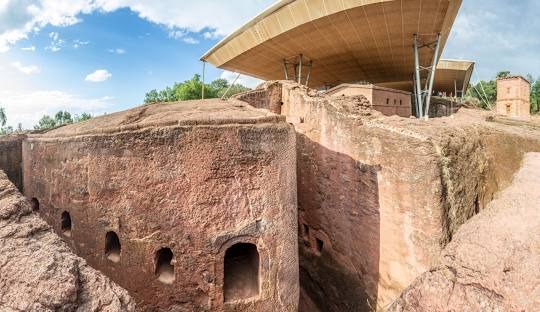
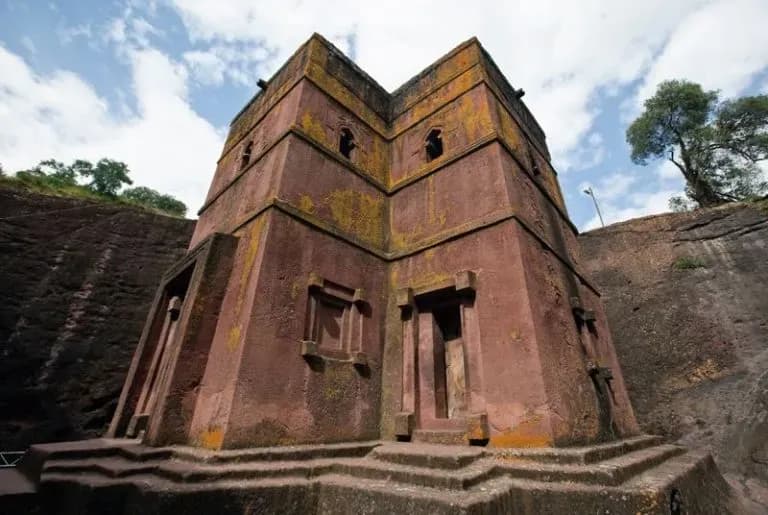
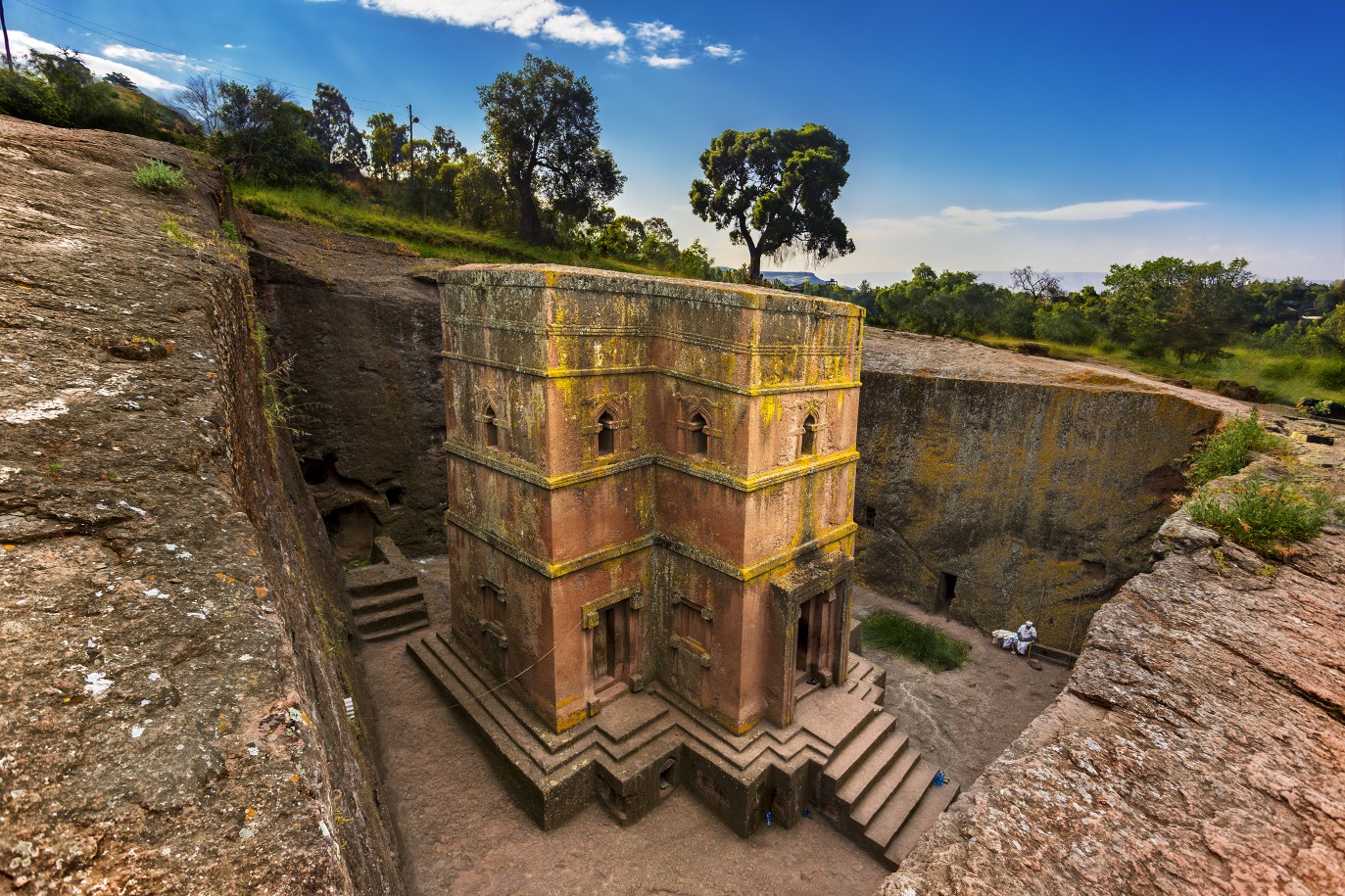
Beta Giorghis presents itself as a tower resting on a base of three steps, with a perfect Greek cross floor plan. The walls rise to approximately 12 meters high and 11 meters on each side. To expose it, builders extracted roughly 3,400 m³ of tuff to excavate the surrounding courtyard, then an additional 450 m³ to hollow out the interior. The building is attached to the ground only at its base; it is isolated from the plateau by a deep trench.
The roof and façades
The flat roof bears a sculpted pattern of a cross inscribed within another cross, both symbolic and functional: channels drain rainwater and direct it outward through spouts beneath the cornice. The lower windows reflect Axumite style, while the upper stories are adorned with floral ogives comparable to those of Bete Golgotha.
The interior
The central space is covered by a ceiling where a large sculpted cross has each of its arms supported by a barrel arch, extended by pilasters at the four corners. The sanctuary dedicated to Saint George is austere. Behind a curtain, out of visitors' view, rests a replica of the Ark of the Covenant, reserved for priests.
Practical information
- Ticket: a single ticket grants access to all eleven monolithic churches of Lalibela, valid for multiple days. Expect a high price by local standards.
- Hours: the site is open daily from morning until late afternoon. Services may temporarily restrict access.
- Dress code: shoulders and knees must be covered. Shoe removal is mandatory before entering the church.
- Local guide: recommended to understand the architectural symbolism and connections between the different churches.
- Duration of visit: plan 45 minutes to 1 hour for Beta Giorghis alone; a full day for the entire Lalibela site.
When to visit
The dry season, from October to March, offers the best visiting conditions: clear skies, passable trails, and favorable light for photography. July and August, during the rainy season, make the rock slippery and access to the canyon more difficult.
The highlight of the year is the Timkat (or Timqet) festival, celebrated each January 19 (January 20 in leap years). This commemoration of Christ's baptism draws thousands of pilgrims to Lalibela in white robes, clergy in liturgical vestments, and processions around the churches. Crowds are substantial: you must book accommodation and flights several months in advance.
How to get there
By air from Addis Ababa
The simplest means is a domestic flight between Addis Ababa and Lalibela airport (code LLI). The journey takes approximately 1 hour. The airport is about twenty kilometers from downtown, connected by taxis, hotel shuttles, and tuk-tuks.
By road
The road journey from Addis Ababa takes 10 to 12 hours through the highlands. This option is more economical but taxing; it can be undertaken in stages, for example via Bahir Dar or Dessie.
On site
Beta Giorghis is located approximately 15 minutes' walk from central Lalibela, slightly apart from the two main church clusters. Access is via a narrow canyon carved into the rock, descending in a spiral and continuing as a tunnel: the church reveals itself only at the last moment, hidden until the final steps.
What to see nearby
Beta Giorghis is visited as part of the broader Lalibela rock-hewn site. The northeastern group, sometimes called "Earthly Jerusalem," brings together Bete Medhane Alem (the largest monolithic church in the world), Bete Maryam, and Bete Golgotha. The southeastern group, or "Heavenly Jerusalem," includes Bete Amanuel and Bete Abba Libanos. The two ensembles are linked by a network of tunnels and passages.
More broadly across Éthiopie, other sanctuaries enhance the discovery of Orthodox Christianity: the Abreha Atsbeha Church in Tigré, or Debre Birhan Selassie Church in Gondar, famous for its frescoes of angels. For landscapes of quite a different character, the Danakil depression and villages of the Omo valley (Dassenech, Dorze) extend the journey toward the south of the country.
Frequently asked questions
Frequently asked questions
Visit Beta Giorghis with Nomadays
Beta Giorghis features in most of our cultural itineraries in Éthiopie, usually combined with Gondar, Lake Tana, the Simien massif, or the Omo valley. To prepare your trip and build a custom itinerary, consult our proposals on the Éthiopie travel page.
Interested in this visit?
We can include it in your personalised itinerary.